
Oarisma poweshiek
(Parker, 1870)
Poweshiek Skipperling
The Poweshiek skipperling is a small, critically endangered North American grass . Historically common across tallgrass prairie systems of the upper Midwest United States and southern Manitoba, Canada, it has experienced catastrophic declines since 2005. The now persists at only six verified extant sites: four prairie fens in Michigan, one mesic prairie in Wisconsin, and one tallgrass prairie in Manitoba. Intensive conservation efforts include captive breeding programs at the Minnesota Zoo and Assiniboine Park Conservancy, federal protection in both countries, and restoration initiatives.

Pronunciation
How to pronounce Oarisma poweshiek: /oʊˈæɹɪzmə ˈpaʊʃiːk/
These audio files are automatically generated. While they are not always 100% accurate, they are a good starting point.
Identification
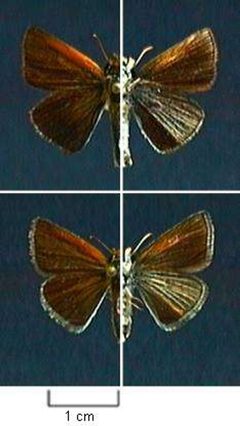
Distinguished from similar grass skippers by combination of small size (24–30 mm wingspan), dark brown upperside with orange restricted to costal margin, and dark grey hindwing underside with conspicuous white . Distinguished from western Oarisma garita by geographic range and subtle wing pattern differences; misidentifications have occurred in historical records.
Images
Appearance
Small with wingspan of 24–30 mm. Upperside dark brown with orange along the . Underside of hindwings dark grey with white .
Habitat
Tallgrass prairie and prairie fen . In Michigan, occupies prairie fens with open vegetation structure and abundant nectar sources, particularly Dasiphora fruticosa. In Manitoba, uses tallgrass prairie with microhabitats distributed along soil moisture gradients: -laying associated with mesic sections, resting/basking with drier sections, and nectar feeding across the gradient. Occupied sites characterized by early successional prairie conditions maintained by disturbance.
Distribution
Historic range: ten U.S. states (Illinois, Indiana, Iowa, Michigan, Minnesota, Nebraska, North Dakota, Ohio, South Dakota, Wisconsin) and southeastern Manitoba, Canada. Current range reduced to approximately 1% of historic extent; six extant at range margins: four in Michigan prairie fens, one in Wisconsin mesic prairie, and one in Manitoba tallgrass prairie. Previously unknown records from Nebraska and Ohio discovered through occurrence data .
Seasonality
with period from late June to mid-July. Adult lifespan approximately two weeks. Exact timing varies with weather conditions; warm early springs favor earlier .
Diet
nectar on flowers; females most frequently observed on Dasiphora fruticosa, males most often on Rudbeckia hirta. Larvae feed on graminoid plants including Andropogon gerardi, Muhlenbergia richardsonis, Muhlenbergia glomerata, Sporobolus heterolepis, Schizachyrium scoparium, and Carex sterilis, alternating between throughout development.
Host Associations
- Andropogon gerardi - larval Poaceae, big bluestem
- Muhlenbergia richardsonis - larval Poaceae; documented oviposition site
- Muhlenbergia glomerata - larval Poaceae; documented oviposition site
- Sporobolus heterolepis - larval Poaceae, prairie dropseed
- Schizachyrium scoparium - larval Poaceae, little bluestem; also indicator of occupied sites
- Carex sterilis - larval Cyperaceae; documented oviposition site
- Dasiphora fruticosa - nectar sourceRosaceae, shrubby cinquefoil; primary nectar plant for females, also oviposition site
- Rudbeckia hirta - nectar sourceAsteraceae, black-eyed Susan; primary nectar plant for males, strong predictor of abundance in Manitoba
Life Cycle
(one per year). laid on plants in mid-summer. Larvae feed on graminoid shoots, navigating microhabitats to locate host plants and alternating between throughout development. Larvae likely enter as partially grown individuals, in prairie vegetation. occurs in spring; eclose in late June to mid-July. Development sensitive to temperature: accumulation from egg hatch to eclosure similar to O. garita, but with lower variability suggesting reduced to climate change.
Behavior
exhibit activity patterns distributed along soil moisture gradients: -laying concentrated in mesic areas, resting and basking in drier areas, nectar feeding across moisture conditions. Adults fly almost exclusively within prairie plant , rarely in shrub or ephemeral wetland communities, never observed in wetland or forest. Larvae navigate microhabitats to locate plants, demonstrating active foraging . Breeding behaviors in captivity positively associated with sunlight intensity, negatively associated with adult age; no detected effect of ambient temperature on breeding behavior frequency.
Ecological Role
of prairie wildflowers, particularly Dasiphora fruticosa and Rudbeckia hirta. herbivore of native prairie grasses and sedges. Serves as for high-quality tallgrass prairie and prairie fen . Poor disperser with limited long-distance movement capability.
Human Relevance
Subject of intensive conservation efforts due to endangered status. Federally endangered in United States (2014) and Canada (SARA endangered status 2019). Captive breeding programs at Minnesota Zoo and Assiniboine Park Conservancy have released over 800 individuals combined. use limitation areas established by EPA to protect remaining . Research subject for studies on prairie management effects, climate change sensitivity, and conservation genetics. Named for Iowa county of Poweshiek.
Similar Taxa
- Oarisma garitaWestern with overlapping morphological features; distinguished by geographic range and greater developmental variability suggesting higher climate
More Details
Conservation Status Timeline
NatureServe G1 (critically imperiled); US ESA endangered 2014; COSEWIC threatened 2003, endangered 2014; Canada SARA threatened 2005, endangered 2019. crash occurred between 2005–2015 after being historically common.
Captive Breeding Achievements
Minnesota Zoo initiated captive rearing in 2018, releasing over 100 individuals in 2022. Assiniboine Park Conservancy Grassland Conservation Program released over 700 individuals and completed first reintroduction at extirpated site.
Management Sensitivity
Abundance negatively associated with years since burning or grazing, indicating need for regular disturbance to maintain early successional . However, widespread adoption of prescribed burning correlated with regional declines, suggesting complex management trade-offs. Cumulative May–June precipitation negatively affects abundance; warm early springs and cool temperatures during active period have positive effects.
Genetic Considerations
Historical was high across the range despite poor ability, facilitated by formerly widespread prairie . Current weakly differentiated genetically but with low diversity, informing reintroduction strategies to maintain gene flow networks.
Sources and further reading
- BugGuide
- Wikipedia
- GBIF taxonomy match
- iNaturalist taxon
- rusty patched bumble bee and Poweshiek skipperling - Entomology Today
- A Brief Guide to Pesticide Mitigations, Label Changes to Protect Endangered Species
- pesticide use limitation areas - Entomology Today
- Flaming the debate | Beetles In The Bush
- Aggregated occurrence records of the federally endangered Poweshiek skipperling (Oarisma poweshiek)
- Life history and ecology of the endangered Poweshiek skipperling Oarisma poweshiek in Michigan prairie fens
- Management practices benefit endangered Poweshiek skipperling (Oarisma poweshiek) in Manitoba tall grass prairie
- Endangered Oarisma poweshiek larvae vary their graminoid forage in Manitoba, Canada
- Endangered Oarisma poweshiek butterfly larval foraging and adult habitat interactions in Manitoba, Canada
- A field‐validated species distribution model to support management of the critically endangered Poweshiek skipperling ( Oarisma poweshiek ) butterfly in Canada
- Adult activities of endangered Oarisma poweshiek butterflies are associated with a soil moisture gradient in tall grass prairie in Manitoba, Canada
- Breeding Behaviors of the Endangered Prairie Butterfly Oarisma poweshiek (Lepidoptera: Hesperiidae) in Relation to Environmental Factors in an Ex Situ Conservation Setting
- Conservation genetics of an endangered grassland butterfly ( Oarisma poweshiek ) reveals historically high gene flow despite recent and rapid range loss
- The role of ambient temperature in the ontogeny of endangered Oarisma poweshiek and their relative O. garita reared ex-situ at Assiniboine Park Zoo, Manitoba
- Habitat Suitability Modeling of the Federally Endangered Poweshiek Skipperling in Michigan
- Local- and Landscape-Level Variables Related to Poweshiek Skipperling Presence in Michigan Prairie Fens