
Amblyscirtes hegon
(Scudder, 1863)
pepper-and-salt skipper
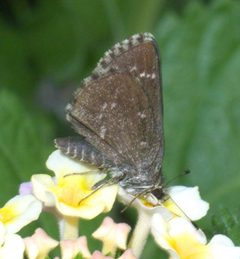
Amblyscirtes hegon, commonly known as the pepper-and-salt skipper, is a small grass-feeding native to eastern and central North America. It is distinguished by its relatively early spring period and association with grassy . The has a single per year and is mostly absent from coastal plain regions within its range.

Pronunciation
How to pronounce Amblyscirtes hegon: /ˌæmblɪˈskɜrtiːz ˈheɡɒn/
These audio files are automatically generated. While they are not always 100% accurate, they are a good starting point.
Identification
Distinguished from other Amblyscirtes by the combination of small size, pepper-and-salt wing pattern, and early spring period (April–July). The common roadside-skipper (A. vialis) is similar but has a more diffuse, less distinct spotting pattern and flies later in the season. The lace-winged roadside-skipper (A. aesculapius) has more prominent pale markings and different preferences. The Nysa roadside-skipper (A. nysa) occurs in the southwestern United States and does not overlap geographically. Examination of underside hindwing pattern and flight timing helps confirm identification.
Images
Appearance
Small skipper with wingspan of 25–31 mm. Upper wing surfaces are dark brown to black with scattered pale spots creating a pepper-and-salt pattern. Underside of hindwing typically grayish with fine dark speckling. Body is compact and robust, typical of grass skippers. are relatively short with hooked clubs. Sexes are similar in appearance, with males possibly showing slightly more extensive pale spotting.
Habitat
Grassy areas including meadows, prairies, open woodlands, and roadsides. Favors with larval grasses present. Mostly absent from coastal plain regions, showing preference for inland and upland areas.
Distribution
Eastern and central North America: from Nova Scotia and Maine west to southern Manitoba, south to Georgia, northern Florida, and southeastern Texas. Notable absence from the Atlantic and Gulf coastal plains throughout much of its range.
Seasonality
active from April to July. Single () per year throughout range. Peak varies geographically, with earlier in southern portions of range.
Diet
Larvae feed on specific grass : Poa pratensis (Kentucky bluegrass), Sorghastrum nutans (Indiangrass), Sorghastrum secundum, and Chasmanthium latifolia (river oats). feed on flower nectar, with documented visits to Viburnum and Rubus (blackberry) flowers.
Host Associations
- Poa pratensis - larval food plantKentucky bluegrass
- Sorghastrum nutans - larval food plantIndiangrass
- Sorghastrum secundum - larval food plant
- Chasmanthium latifolia - larval food plantriver oats
- Viburnum - nectar source
- Rubus - nectar sourceblackberry
Life Cycle
One per year. Larvae feed on grasses and presumably overwinter in some stage, though specific stage is not well documented. emerge in spring and early summer. Complete details for pupal stage and exact overwintering form require further documentation.
Behavior
fly low through grassy vegetation. Males perch on low vegetation to await females. Both sexes visit flowers for nectar. is rapid and darting, typical of small skippers. Early morning activity has been observed, with potential afternoon retreat to shaded areas during hot weather ( inferred from congeneric ).
Ecological Role
Larval herbivore on native and introduced grasses. of flowering plants. Serves as prey for insectivorous birds, spiders, and other . Part of grassland and open .
Human Relevance
Minor interest to watchers and naturalists due to early period. Not of economic importance. Presence indicates healthy grassland or open woodland with native grass components. No known pest status.
Similar Taxa
- Amblyscirtes vialisCommon roadside-skipper overlaps in range and but has less distinct pepper-and-salt pattern and flies later (May–September)
- Amblyscirtes aesculapiusLace-winged roadside-skipper has more prominent pale markings and prefers different
- Amblyscirtes nysaNysa roadside-skipper is geographically separated, occurring in southwestern US and not overlapping with A. hegon range
More Details
Taxonomic Note
Some sources indicate this has been moved to Mastor as Mastor hegon, though Amblyscirtes hegon remains widely used in North American literature and databases.
Conservation Status
Not formally assessed; appears secure throughout range but dependent on grassland preservation.