
Euphyes dukesi
(Lindsey, 1923)
Dukes' skipper
Euphyes dukesi, known as Dukes' skipper, is a small wetland-associated to eastern North America. The exhibits a fragmented distribution across three geographically isolated : the Atlantic coastal plain, the lower Mississippi Valley, and the Great Lakes region. It is strictly associated with shaded wetland where sedges serve as larval plants. The species was first described in 1923 from Alabama and named for collector W. C. Dukes. Two are recognized: the nominate form and the Florida-endemic E. d. calhouni, which occupies swamp habitats with distinct morphological differences.
Pronunciation
How to pronounce Euphyes dukesi: //ˈjuːfiː.iːz ˈduːksiː//
These audio files are automatically generated. While they are not always 100% accurate, they are a good starting point.
Identification
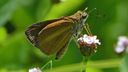
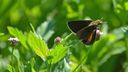
The single yellowish streak on the hindwing is diagnostic and separates it from other Euphyes . Males can be distinguished by the black stigma on the forewing; females by the pale yellow spots on the hindwing band. The Florida E. d. calhouni is darker overall with diffuse rather than bold yellow markings, and dark wing fringes matching the ground color. The nominate subspecies has lighter fringes and more heavily scaled, boldly extending yellow dashes on fresh specimens.
Images
Habitat
Strictly associated with shaded wetlands including woodland swamps, coastal swamps, marshes, and ditches. The Florida E. d. calhouni occupies swamp with large stands of sedge plants. Requires presence of specific sedge for larval development.
Distribution
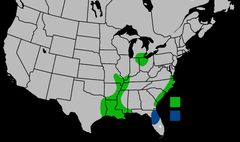
Three distinct regionally clustered : (1) Atlantic Coast from southeastern Virginia to northern peninsular Florida; (2) lower Mississippi Valley from central Missouri and southern Illinois south to Gulf Coast; (3) extreme southwestern Ontario, southeastern Michigan, northeastern Indiana, and northern Ohio. Canadian presence limited to small portion of southern Ontario. The split distribution pattern is hypothesized to reflect Pleistocene glacial displacement followed by post-glacial through Mississippi and Mohawk valley corridors.
Seasonality
Voltinism varies geographically: in northern with single around July; from western Kentucky and Virginia southward with broods around June and August-September; potentially trivoltine in Florida where E. d. calhouni may fly from mid-May through October. periods last approximately one month per brood.
Diet
Larvae feed exclusively on sedges (Cyperaceae): Carex lacustris in northern , Carex hyalinolepis in Mississippi River basin, Carex lupuliformis, Carex walteriana, Carex striata in southeast, and Rhynchospora inundata and Rynchospora miliacea in Florida. nectar on diverse flowers including Cephalanthus occidentalis, Asclepias syriaca, Asclepias incarnata, Eupatorium maculatum, Eupatorium coelestinum, Pontederia cordata, Hibiscus , Helenium autumnale, Medicago sativa, and Trifolium pratense.
Host Associations
- Carex lacustris - LARVAL_HOSThairy sedge; northern
- Carex hyalinolepis - LARVAL_HOSTshoreline sedge; Mississippi River basin
- Carex lupuliformis - LARVAL_HOSTfalse hop sedge
- Carex walteriana - LARVAL_HOST
- Carex striata - LARVAL_HOSTWalter's sedge; southeast
- Rhynchospora inundata - LARVAL_HOSTnarrowfruit horned beaksedge; Florida
- Rynchospora miliacea - LARVAL_HOSTmillet beaksedge; Florida
Life Cycle
laid singly on undersides of plant leaves. Larvae undergo several , in fourth instar to overwinter, resume feeding and molt once more in spring, then pupate for approximately two weeks. lifespan estimated at three weeks; total lifespan from hatching approximately one year or less.
Ecological Role
herbivore of wetland sedges; pollination services through nectar feeding. The strict association makes it a potential for shaded wetland integrity.
Human Relevance
Named for W. C. Dukes of Mobile, Alabama, who collected the first specimen in 1922. Subject of conservation concern: listed as threatened in Michigan, vulnerable on Xerces Society Red List, and N3 (vulnerable) nationally in United States, N2 (imperiled) in Canada, with global G3 (vulnerable) status. Not assessed by IUCN or covered by US or Canadian federal legislation.
Similar Taxa
- Euphyes berryiSimilar wetland and appearance; 'Florida swamp skipper' has been proposed for both , causing potential confusion
- Other Euphyes speciesGeneral similarity in size and brown coloration; distinguished by the diagnostic single yellowish streak on hindwing of E. dukesi