
Euphyes berryi
(Bell, 1941)
Berry's skipper, Florida swamp skipper
Euphyes berryi is a rare skipper butterfly to the southeastern United States coastal plain. It inhabits specialized wetland environments including wet prairies, marshes, and pitcher plant savannas. The significant conservation concerns, with a NatureServe status of G1G3 (critically imperiled to vulnerable) and possible extirpation from parts of its historic range. Identification is challenging due to close resemblance to related Euphyes species.
Pronunciation
How to pronounce Euphyes berryi: //ˈjuːfaɪ.iːz ˈbɛɹ.iː//
These audio files are automatically generated. While they are not always 100% accurate, they are a good starting point.
Identification
Difficult to distinguish from Euphyes dion and Euphyes byssus, particularly individuals that lack normal hindwing patterns. The combination of paler yellowish fulvous on hindwing undersides with overall size and coloration may aid separation, but expert verification is often required.
Images
Appearance
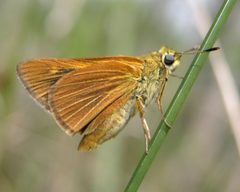
males have a wingspan of 36–38 mm; females are slightly larger at 38–42 mm. Body and are brownish to fulvous (dull brownish yellow). are black above and fulvous beneath. Male wings are bright fulvous on the upperside, darker brownish fulvous on the underside, with darker brown borders and spot patterns. Female wings are mostly black-brown on the upperside with dark fulvous undersides. Both sexes show distinctly paler, yellowish fulvous on the hindwing undersides.
Habitat
Wet areas near ponds and swamps, specifically wet prairies, marshes, and savannas containing pitcher plants (Sarracenia spp.). is characterized by open wetlands rather than closed- swamps.
Distribution
Historic range extends along outer coastal plains from Dare County, North Carolina south through South Carolina and Georgia to southern Florida. May be extirpated from portions of this range.
Seasonality
reported from March to October, likely representing two . Larvae overwinter.
Diet
Larvae feed on sedges, probably one or more Carex . take nectar from various flowers including pickerelweed (Pontederia spp.).
Host Associations
- Carex - larval food plantspecific not confirmed
- Pontederia - nectar sourcepickerelweed
Life Cycle
Larvae overwinter. emerge in two annually, with period spanning March through October.
Ecological Role
may contribute to pollination of wetland flowers including Pontederia. Larval herbivory on sedges likely has localized nutrient cycling effects in specialized wetland .
Human Relevance
Named for Dean F. Berry of Orlando, Florida, who collected most of the . Conservation concern due to loss and degradation of southeastern wetland .
Similar Taxa
- Euphyes dionIndividuals lacking normal hindwing patterns closely resemble E. berryi; requires careful examination of wing venation and coloration.
- Euphyes byssusSimilar size and coloration; hindwing pattern variations can produce individuals nearly indistinguishable from E. berryi.
- Euphyes dukesiProposed 'Florida swamp skipper' was also suggested for E. dukesi , creating potential confusion; the two occupy different and ranges.
Misconceptions
The proposed 'Florida swamp skipper' is misleading: the is not to Florida and inhabits open wetlands rather than swamps. This name was more appropriately applied to Euphyes dukesi calhouni.
More Details
Etymology
Named by Ernest Layton Bell in 1941 for Dean F. Berry of Orlando, Florida, who collected most of the specimens used in the original description.
Conservation Status
NatureServe global status G1G3 (2015 review), reflecting significant uncertainty due to limited knowledge; rounded average of G2 (imperiled). loss and degradation of southeastern wetlands are primary threats.