
Problema bulenta
(Boisduval & Le Conte, 1833)
Rare Skipper
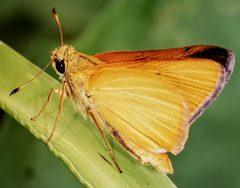
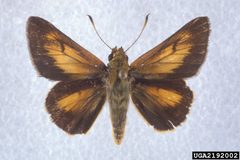
Problema bulenta, commonly known as the rare skipper, is a in the Hesperiidae. It is one of the most elusive butterflies in the United States, with restricted to isolated brackish river marshes along the Atlantic Coast. The was first described from a drawing by John Abbot in Georgia, with no specimens collected again until the 1920s. Its extreme rarity and specific requirements have made it a subject of conservation concern.
Pronunciation
How to pronounce Problema bulenta: /proʊˈbleɪmə bjuːˈlɛntə/
These audio files are automatically generated. While they are not always 100% accurate, they are a good starting point.
Identification
The rare skipper is difficult to distinguish from other marsh-dwelling skippers without close examination. Its restricted in brackish river marshes is a key clue to identification. The is known to occur only in specific river systems, so location is diagnostic. Specimens require expert verification due to similarity with other Problema species and marsh skippers.
Images
Appearance
Wingspan 39–54 mm (1.5–2.1 in). The wingspan was incorrectly reported as 3.9–5.4 mm in some sources.
Habitat
Brackish river marshes and abandoned rice paddies. are restricted to specific tidal river systems with salt marsh vegetation.
Distribution
Isolated along the Atlantic Coast of the United States from southern New Jersey south to Georgia. Documented from the Chickahominy River (Virginia), Wicomico River (Maryland), Cape Fear River (North Carolina), Santee River (South Carolina), Savannah River (Georgia), and additional sites in Delaware and New Jersey.
Seasonality
are active in late spring and summer. In the northern part of the range, females produce one in June. In the southern range, females produce two broods, one in May to June and another in late July to September.
Diet
feed on nectar of Pontederia cordata (pickerelweed) and Asclepias incarnata (swamp milkweed). Larvae feed on tall cordgrass (Spartina alterniflora) and giant cutgrass (Zizaniopsis miliacea).
Host Associations
- Pontederia cordata - nectar source
- Asclepias incarnata - nectar source
- Spartina alterniflora - larval food planttall cordgrass
- Zizaniopsis miliacea - larval food plantgiant cutgrass
Life Cycle
are laid in late spring to summer depending on latitude. Larvae likely overwinter during the middle instar stage, with development resuming as temperatures increase. and follow in spring to early summer. The complete has not been fully documented due to the ' rarity.
Behavior
have been observed feeding on nectar at specific flowers. The is rarely encountered even within its known range, suggesting low and possibly secretive habits.
Ecological Role
As a herbivore, larvae consume marsh grasses. may contribute to pollination of their nectar plants. The is part of the specialized fauna of brackish marsh .
Human Relevance
The rare skipper has been considered for threatened or endangered listing due to its extreme rarity and vulnerability. in Delaware have been significantly impacted by mosquito control spraying. Habitat loss from housing and recreational development threatens remaining populations. The has been the subject of intensive search efforts by lepidopterists, with specimens deposited in Yale University Peabody Museum of Natural History, Cornell University Entomology Collection, and other institutions.
Similar Taxa
- Other Problema speciesSimilar ; require genitalia examination or geographic separation for identification
- Other marsh-dwelling HesperiidaeShared and general skipper ; identification requires expert examination
More Details
Discovery history
First described from a drawing by John Abbot in Georgia in the early 19th century. No specimens were collected again until the 1920s near Wilmington, North Carolina. Rediscovered in Virginia in 1973 and Maryland in 1984. Range expanded to include New Jersey in the 1980s.
Conservation status
Considered a candidate for threatened or endangered listing in 1993. remain small and isolated, with degradation from development and use ongoing concerns.
Sources and further reading
- BugGuide
- Wikipedia
- GBIF taxonomy match
- iNaturalist taxon
- Catalogue of Life
- How Crickets Can "Upcycle" Bad Grain Into Useful Animal Feed
- Naming a Bug After a Droid: The Case of Kaytuesso flavolateralis
- Alfalfa Weevil: New Integrated Pest Management Guide Available
- Bug Eric: Flying Ants
- Bug Eric: The Changing Conversation Around Invasive Species
- Study Confirms Effectiveness of Cheap, Simple Traps for Citizen Science Project