
Euphyes dion
(Edwards, 1879)
Dion Skipper, Alabama Skipper
Euphyes dion is a native to eastern and central North America. are active from July to early August in northern and from May to September in southern populations, where two occur per year. The is listed as a species of special concern in Connecticut. Larvae feed on sedges, while adults visit nectar sources including pickerelweed and buttonbush.
Pronunciation
How to pronounce Euphyes dion: /ˈjuːfi.ez ˈdaɪˌɒn/
These audio files are automatically generated. While they are not always 100% accurate, they are a good starting point.
Identification
Distinguished from similar Euphyes by geographic range and . The two (E. d. dion and E. d. alabamae) may show subtle morphological differences, though specific diagnostic characters are not detailed in available sources. in northern are active in mid-summer (July–August), while southern populations have a pattern (May–September).
Images
Appearance
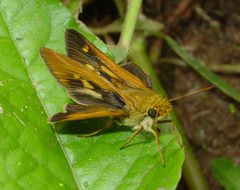
Wingspan 37–45 mm. A medium-sized skipper with typical Hesperiidae : stocky body, large , and with hooked clubs. Wing coloration and pattern details are not specified in available sources.
Habitat
Associated with wetland where larval sedges occur. Scattered occur in diverse environments from Atlantic coastal regions to prairie-woodland transition zones.
Distribution
North America: western Massachusetts and southeastern New York south to northeastern Florida, west to northeastern Texas, north to southeastern North Dakota, northern Wisconsin, southern Ontario, and southern Quebec. are scattered and discontinuous across this range.
Seasonality
in the north: active July to early August. in the south: adults active May to September.
Diet
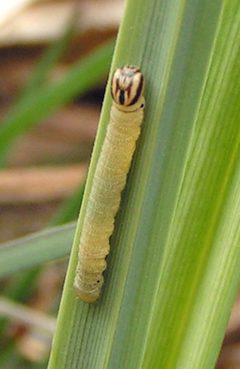
Larvae feed on sedges: Scirpus cyperinus, Carex lacustris, and Carex hyalinolepis. feed on nectar from pickerelweed, sneezeweed, buttonbush, and Alsike clover.
Host Associations
- Scirpus cyperinus - larval sedge
- Carex lacustris - larval sedge
- Carex hyalinolepis - larval sedge
- Pontederia cordata - nectar sourcepickerelweed
- Helenium autumnale - nectar sourcesneezeweed
- Cephalanthus occidentalis - nectar sourcebuttonbush
- Trifolium hybridum - nectar sourceAlsike clover
Life Cycle
Complete with , larva, pupa, and stages. One per year in northern range; two generations per year in southern range. Specific details of egg-laying , larval instars, and stage are not documented in available sources.
Ecological Role
function as when visiting flowers for nectar. Larvae are herbivores on sedges, potentially contributing to nutrient cycling in wetland .
Human Relevance
Listed as a of special concern in Connecticut, indicating conservation interest. No significant economic or agricultural impact documented.
Similar Taxa
- Other Euphyes speciesCongeneric skippers share general ; precise differentiation requires examination of genitalia or geographic/phenological data not fully detailed in available sources.
More Details
Subspecies
Two recognized : Euphyes dion dion and Euphyes dion alabamae (Lindsey, 1923). The latter was described from Alabama, though modern taxonomic treatment of these forms is not detailed in available sources.
Conservation Status
of special concern in Connecticut. No federal listing or IUCN assessment found in available sources.