
Autographa ampla
(Walker, 1858)
Large Looper Moth, Raspberry Looper, Brown-patched Looper, Broken-banded Y
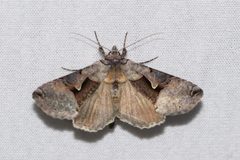
Autographa ampla, known as the large looper or broken-banded Y, is a Noctuidae moth first described by Francis Walker in 1858. It has a wingspan of 38–42 mm and is found across much of North America, from Newfoundland to Alaska and south to California, Arizona, New Mexico, and North Carolina. are active from June to August with one per year.


Pronunciation
How to pronounce Autographa ampla: //ɔːˈtɒɡrəfə ˈæmplə//
These audio files are automatically generated. While they are not always 100% accurate, they are a good starting point.
Identification
Distinguished from similar Autographa by the broken or incomplete Y-shaped marking on the forewing. The 'broken-banded Y' directly references this diagnostic feature. The species is larger than many related loopers, with the wingspan of 38–42 mm exceeding that of smaller . The brown-patched looper common name suggests distinct darker patches on the forewing that aid identification. Separation from the alfalfa looper (Autographa californica) requires examination of wing pattern details and geographic overlap in western North America.
Images
Appearance
Medium-sized with wingspan of 38–42 mm. Forewing pattern includes a characteristic broken or incomplete Y-shaped or Y-like marking, contributing to the 'broken-banded Y'. Coloration is variable but generally includes brownish, grayish, and blackish tones with mottled patterning. Hindwings are typically paler. The specific epithet 'ampla' (Latin for 'large' or 'spacious') refers to its relatively substantial size compared to related .
Habitat
Found in diverse environments across its broad North American range, including forests, woodlands, shrublands, and agricultural areas. The 'raspberry looper' suggests association with Rubus , though specific plant relationships require confirmation. Occurs from sea level to montane elevations, with distribution spanning multiple ecoregions from forests to chaparral and desert margins.
Distribution
North America: Newfoundland west to Alaska panhandle, south to central California, Arizona, and New Mexico in the west, and to North Carolina in the east. Canadian records include Alberta, Manitoba, and Saskatchewan. US records include Vermont and other states within the described range.
Seasonality
active from June to August, with exact timing depending on location. One per year ().
Life Cycle
One per year. Larval stage presumably feeds on herbaceous plants as in related Autographa , though specific records for this species are not documented in provided sources. likely occurs in soil or leaf litter. emerge in early summer.
Behavior
are and attracted to light. Like other Noctuidae, they likely rest with wings folded flat over the or in a tent-like posture, though specific resting posture for this is not documented.
Similar Taxa
- Autographa californicaAlfalfa looper moth overlaps in western North America; similar size and general appearance but differs in wing pattern details and complete versus broken Y-marking
- Autographa gammaSilver Y is a related European with similar Y-shaped forewing marking; distinguished by geographic range and complete versus broken banding
More Details
Etymology
The specific epithet 'ampla' is Latin for 'large' or 'spacious', referring to the relatively substantial size of this compared to related loopers. The 'broken-banded Y' directly describes the diagnostic forewing pattern.
Sources and further reading
- BugGuide
- Wikipedia
- GBIF taxonomy match
- iNaturalist taxon
- NCBI Taxonomy
- Catalogue of Life
- Do Moths Usually Land with Their Wings Down? | Bug Squad
- In the Loop--on the Mustard | Bug Squad
- Bug Squad
- Bug Eric: New Mexico Dragonfly Blitz - Day 3
- Insect Migration (Part 1) - Buglife Blog - Buglife
- Mudo Pryfed (Rhan 1) - Buglife Blog - Buglife