
Tathorhynchus exsiccata
(Lederer, 1855)
Levant blackneck, Alfalfa Looper Moth
Tathorhynchus exsiccata is a in the Erebidae, known as the Levant blackneck. The nominate form occurs across the Canary Islands, North Africa, Tropical Asia, and Tropical Africa. It has been introduced to Dominica and Argentina. A distinct , T. e. fallax, occupies the northern half of Australia, Norfolk Island, and New Zealand.


Pronunciation
How to pronounce Tathorhynchus exsiccata: /tætoʊˈrɪŋkəs ɛkˈsɪkətə/
These audio files are automatically generated. While they are not always 100% accurate, they are a good starting point.
Identification
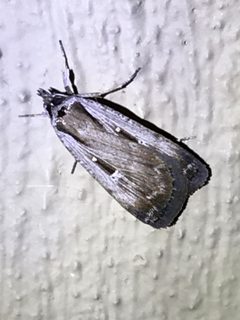
The dark thoracic collar (black neck) is the most reliable field mark. Distinguished from similar noctuid/erebid by the combination of plain pale hindwings and the contrasting dark thoracic collar. fallax in Australia and New Zealand is generally paler with reduced markings compared to the nominate form.
Images
Habitat
Found in agricultural areas, grasslands, and open disturbed . Associated with cultivated fields, particularly alfalfa and other legume crops. In introduced ranges, occupies similar anthropogenic open habitats.
Distribution
Native: Canary Islands, North Africa, Tropical Asia, and Tropical Africa. Introduced: Dominica, Argentina. T. e. fallax: northern Australia, Norfolk Island, New Zealand.
Diet
Larvae feed on Fabaceae, particularly alfalfa (Medicago sativa), clovers (Trifolium spp.), and other leguminous crops. do not feed.
Host Associations
- Medicago sativa - larval food plantprimary ; 'Alfalfa Looper ' derives from this association
- Trifolium - larval food plantclovers and related legumes
Life Cycle
Behavior
Larvae exhibit characteristic looping gait due to reduced . are and attracted to light. In agricultural settings, larvae may reach pest densities on legume crops.
Ecological Role
Herbivore in native and introduced ranges; larval stage functions as primary consumer on leguminous plants. In introduced regions, may compete with native herbivores for resources.
Human Relevance
Agricultural pest on alfalfa and other legume crops in some regions. Larval feeding can reduce forage quality and yield. Subject to biological and chemical control in managed agricultural systems. Introduced in Dominica, Argentina, Australia, and New Zealand represent established non-native populations with potential economic impact.
Similar Taxa
- Autographa gammaSimilar size and wing pattern, but lacks dark thoracic collar and has more distinct forewing markings including a silvery Y- or gamma-shaped mark.
- Chrysodeixis eriosomaAnother 'looper' with similar larval habit, but forewings have more contrasting pattern with distinct silvery spots; native to parts of same range but with different thoracic pattern.
More Details
Taxonomic note
Formerly placed in Noctuidae; now classified in Erebidae based on molecular and morphological data. The T. e. fallax was long treated as a separate (Tathorhynchus fallax) but is now synonymized under T. exsiccata.
Introduction history
Introductions to Dominica and Argentina appear to be relatively recent (20th century), likely via agricultural trade. Australian/New Zealand represent the distinct fallax , which may have arrived through natural or human-assisted transport across the Indian Ocean.