
Tathorhynchus
Hampson, 1894
Species Guides
1- Tathorhynchus exsiccata(Levant blackneck)
Tathorhynchus is a in the Erebidae, established by George Hampson in 1894. It contains a single , Tathorhynchus exsiccata (the Levant blackneck or double-spotted snout), described by Julius Lederer in 1855. The genus has undergone taxonomic revision, having been briefly transferred to Lygephila in 2003 before being restored to Tathorhynchus in 2005. The species exhibits two recognized with distinct geographic distributions.


Pronunciation
How to pronounce Tathorhynchus: /ˌtæθoˈrɪŋkəs/
These audio files are automatically generated. While they are not always 100% accurate, they are a good starting point.
Identification
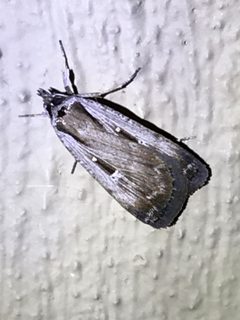
The combination of whitish forewings heavily suffused with grey-brown, the distinctive pattern of pale spots on the and stigmata separated by a black dash, and the terminal row of black lunules distinguishes this from similar erebid . The greyish-white hindwing with darker terminal area is also characteristic. Similar Lygephila species lack this specific spot arrangement.
Images
Appearance
have forewings that are whitish and thickly suffused with grey-brown, darker towards the termen. The and stigmata are marked by pale spots separated by a black dash, with another pale spot beyond the reniform. The outer line is pale and preceded by black marks, and there is a terminal row of black lunules. The hindwing is greyish white, darker terminally. Wingspan is approximately 40 mm.
Habitat
Found in tropical and subtropical regions; the nominate occurs in North African, tropical African, and tropical Asian , while T. e. fallax occupies grassland and agricultural areas in Australia, Norfolk Island, and New Zealand.
Distribution
Native to the Canary Islands, North Africa, tropical Asia, and tropical Africa. Introduced to Dominica and Argentina. T. e. fallax is native to northern Australia, Norfolk Island, and New Zealand.
Diet
Larvae of the nominate feed on Indigofera tinctoria, Medicago sativa, and Spartium junceum. Larvae of T. e. fallax probably feed on Medicago sativa.
Host Associations
- Indigofera tinctoria - larval food plantnominate
- Medicago sativa - larval food plantboth
- Spartium junceum - larval food plantnominate
Life Cycle
Complete with , larval, pupal, and stages. Larval stage feeds on plants; specific details of and adult timing not documented.
Ecological Role
Larvae function as herbivores on leguminous plants. Potential minor agricultural pest on alfalfa (Medicago sativa) in regions where introduced.
Human Relevance
Minor agricultural significance due to larval feeding on alfalfa and indigo crops. Introduced in Dominica and Argentina suggest human-mediated , possibly through agricultural trade.
Similar Taxa
- LygephilaFormerly included T. exsiccata as Lygephila exsiccata; distinguished by wing pattern details including the specific arrangement of pale spots and black dashes on the forewing.
More Details
Taxonomic History
The has been subject to taxonomic instability. T. exsiccata was transferred to Lygephila by Goater et al. (2003) based on morphological similarities, but Fibiger and Hacker (2005) returned it to Tathorhynchus, a decision now accepted.
Biogeographic Pattern
The disjunct distribution between Old World native range and New World introduced , combined with the Australian/New Zealand , suggests either natural long-distance capability or multiple human-mediated introductions.