
Striacosta albicosta
(Smith, 1888)
Western Bean Cutworm, Western Bean Cutworm Moth
Striacosta albicosta, the western bean , is a noctuid and sole member of its . Historically restricted to the western Great Plains of the United States, it has undergone substantial eastward range expansion since 2000, now occurring throughout the U.S. Corn Belt and into Canada and Mexico. It is a significant agricultural pest of corn and dry beans, with larvae feeding on reproductive structures and causing yield losses up to 40% in corn. The has developed resistance to Cry1F Bt protein, complicating management in transgenic crops.
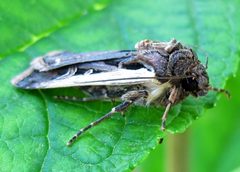
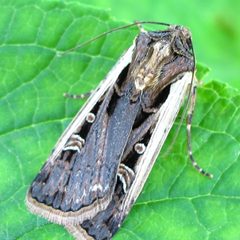
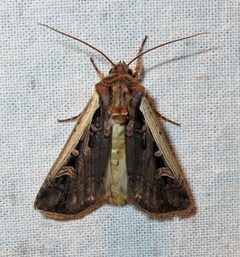
Pronunciation
How to pronounce Striacosta albicosta: /ˌstraɪ.əˈkɒstə ˌæl.bɪˈkɒstə/
These audio files are automatically generated. While they are not always 100% accurate, they are a good starting point.
Identification
Larvae can be distinguished from similar corn ear-feeding pests by specific injury patterns and . Unlike corn earworm (Helicoverpa zea), which typically feeds from the tip of the ear downward, western bean larvae often enter through the side of the ear and may feed on multiple kernels. Larvae have a tan to pinkish body with distinct dark stripes behind the and a dark head capsule. Full-grown larvae reach approximately 40 mm. are tan to brown with a distinctive white stripe along the of the forewing, visible when at rest.
Images
Habitat
Agricultural landscapes dominated by corn and dry bean production. Prepupal and pupal stages occur in soil. The thrives in areas with suitable crop availability and soil conditions for .
Distribution
Native range: western Great Plains of the United States (western Nebraska, Kansas, Idaho, eastern Colorado). Expanded range: since early 2000s, eastward through Iowa, Minnesota, Illinois, Missouri, Indiana, Wisconsin, Michigan, Ohio, Texas, New York, and into southern Canada and Mexico. Currently restricted to North America, though climate modeling indicates suitable conditions for establishment exist in Europe, Asia, Oceania, South America, and Africa.
Diet
Larvae feed on reproductive parts of corn (Zea mays) and dry beans (Phaseolus vulgaris), including kernels, silks, and developing seeds. feeding habits are not documented in available sources.
Host Associations
- Zea mays - primary corn; major crop causing up to 40% yield loss
- Phaseolus vulgaris - primary dry beans; secondary crop causing up to 10% yield loss
Life Cycle
Prepupal and pupal stages occur in soil. Complete details of , larval instars, and timing are not documented in available sources.
Behavior
Larvae are feeders on corn ears and bean pods. The has shown significant range expansion , spreading eastward from its native western range beginning in 1999/early 2000s. are nocturnal and attracted to light.
Ecological Role
Agricultural pest causing direct yield losses and facilitating secondary damage. Larval feeding creates entry points for fungal and other insects, reducing grain quality and marketability. In the Great Lakes region of the U.S. Corn Belt, it serves as a major pest that Vip3Aa Bt toxin effectively controls.
Human Relevance
Significant economic pest of corn and dry bean production. Management relies on Bt transgenic corn, but resistance to Cry1F protein has been documented, reducing efficacy of single-toxin varieties. Vip3Aa toxin remains effective in some regions. Monitoring and proper identification of larval injury are critical for decisions. Range expansion has increased its importance in eastern U.S. corn production areas.
Similar Taxa
- Helicoverpa zeaBoth feed on corn ears; H. zea typically feeds from ear tip downward while S. albicosta enters from side and may feed on multiple kernels; H. zea has more variable coloration and lacks distinct stripes
- Spodoptera frugiperdaBoth are noctuid pests of corn; fall armyworm has distinctive inverted Y on capsule and more gregarious early instar ; injury patterns differ in characteristics and feeding location
More Details
Bt Resistance
Resistance to Cry1F Bt protein has been documented, making this toxin unreliable for management. Vip3Aa toxin remains effective in the Great Lakes region, though resistance management strategies are needed to preserve its efficacy.
Range Expansion Dynamics
The ' rapid eastward expansion since 2000 appears linked to changes in agricultural practices, climate suitability, and potentially reduced competition, though specific drivers are not fully elucidated in available sources.
Sources and further reading
- BugGuide
- GBIF taxonomy match
- iNaturalist taxon
- NCBI Taxonomy
- Catalogue of Life
- Whodunit? Solving Corn Pest Mysteries When Suspects Have Fled the Scene
- The Problems Driving Resistance to Bt Crops—and Some Proposed Solutions
- Striacosta albicosta Archives - Entomology Today
- Modeling of suitable geographic areas for Striacosta albicosta in corn and dry bean crops under climate change scenarios.