
Euxoa sinelinea
Hardwick, 1965
Gray-edged Dart
Euxoa sinelinea is a noctuid described by Hardwick in 1965. As a member of the dart moth Euxoa, it shares the general characteristics of this large and diverse group of owlet moths. The species is documented from parts of western Canada, specifically Alberta and Manitoba. Like other Euxoa species, the larvae are likely cutworms—soil-dwelling caterpillars that feed at or below ground level on plants.
Pronunciation
How to pronounce Euxoa sinelinea: /juːkˈsoʊə sɪniːˈlaɪniə/
These audio files are automatically generated. While they are not always 100% accurate, they are a good starting point.
Identification
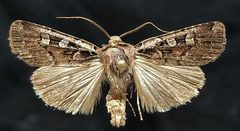
Euxoa sinelinea can be distinguished from similar dart moths by its reduced or absent longitudinal forewing lines, as indicated by its name. It may be confused with other Euxoa species such as E. messoria (Dark-sided ) or E. ochrogaster (Red-backed Cutworm), which typically show more pronounced linear markings. Accurate identification requires examination of genitalia or reference to original species description. The species occurs in a region where several Euxoa species overlap, making field identification challenging without specimen examination.
Images
Appearance
are typical medium-sized noctuid with the characteristic stout body and relatively narrow forewings of the Euxoa. The specific epithet "sinelinea" (Latin for "without line" or "lacking line") suggests a wing pattern reduced or lacking the longitudinal lines common in many related dart moths. Forewings are likely dull gray-brown with subtle patterning. The hindwings are typically paler, often whitish or gray with darker margins in Euxoa . Wingspan and precise coloration details are not well documented in available sources.
Habitat
Distribution
Recorded from Alberta and Manitoba, Canada. GBIF distribution records indicate presence in North America with confirmed occurrences in these two provinces. The full range may extend into adjacent regions but remains poorly documented.
Seasonality
period is not specifically documented for this . Most Euxoa species in similar latitudes have adults active from late spring through summer, with peak activity typically in June and July. Larvae likely overwinter, as is characteristic of the .
Life Cycle
The of Euxoa sinelinea has not been specifically studied. Based on characteristics, the likely has a single per year with larvae and pupating in soil. are probably laid on or near soil surface on plants or debris. Larval development occurs through spring, with in early summer and shortly thereafter.
Behavior
are and attracted to light, as documented for the congeneric Euxoa mimallonis (Ruddy-winged Dart) observed at blacklight in Colorado. Larvae, if following typical Euxoa patterns, are nocturnal surface feeders that hide in soil or debris during daylight hours. When disturbed, larvae characteristically curl into a tight C-shape.
Ecological Role
As a primary consumer in larval stage, this contributes to nutrient cycling and serves as prey for , birds, and other . The Euxoa is known to parasitoids including braconid wasps (Meteorus, Apanteles). likely function as when feeding on nectar, though this has not been specifically documented for E. sinelinea.
Human Relevance
No specific economic impact has been documented for this . Many Euxoa species are agricultural pests as larvae (cutworms), but E. sinelinea is not among the commonly cited pest species in the . It may occasionally be encountered in prairie agricultural systems but is not considered a significant pest.
Similar Taxa
- Euxoa messoriaSimilar size and general appearance; distinguished by presence of dark longitudinal forewing lines that E. sinelinea lacks.
- Euxoa ochrogasterOverlapping range in western Canada; typically shows reddish-brown forewing coloration with more pronounced pattern elements.
- Euxoa auxiliaris is a much better-known with similar general , but has distinct wing pattern and different seasonal including summer to alpine areas.
More Details
Taxonomic history
Described by David F. Hardwick in 1965, this has received limited subsequent study. Hardwick was a in Noctuidae, particularly the Euxoa, and his species descriptions are considered authoritative.
Research needs
Basic including larval plants, precise associations, and full geographic range remain undocumented. The would benefit from focused survey work to clarify its conservation status and ecological requirements.
Sources and further reading
- BugGuide
- GBIF taxonomy match
- iNaturalist taxon
- NCBI Taxonomy
- Aboveground Pests - AgriLife Extension Entomology
- Stem- and Leaf- Feeding Insects - AgriLife Extension Entomology
- Bug Eric: Winter 'pillars
- How Army Cutworm Moths Bounce Between Midwest Heat and Alpine Cool
- Bug Eric: My Kind of Fourth of July
- Bug Eric: July 2019