
Euxoa ochrogaster
(Guenée, 1852)
red-backed cutworm, red-backed cutworm moth
Euxoa ochrogaster, the red-backed , is a Noctuidae with a Holarctic distribution spanning Iceland, northern Europe, and North America from Alaska to Newfoundland and south to Arizona and New Mexico. are active from late July to early September, with tied to accumulated above 12.5°C. The larvae are feeders on broad-leaved plants and grasses, including Plantago , and are economically significant as pests of sunflower (Helianthus annuus) in North America. Laboratory studies indicate possess a moderately severe terminated more quickly at 5°C, with development rates varying inversely with temperature.
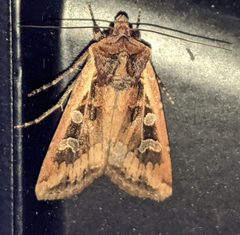
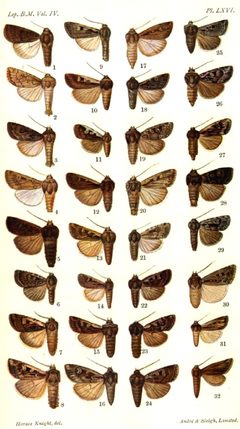
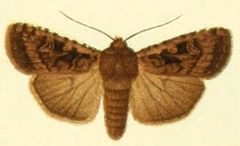
Pronunciation
How to pronounce Euxoa ochrogaster: //juːkˈsoʊə ɔˌkroʊˈɡæstər//
These audio files are automatically generated. While they are not always 100% accurate, they are a good starting point.
Identification
are and attracted to light. Synthetic sex attractants have been developed with 99.6% specificity for this , allowing effective monitoring and separation from such as Euxoa messoria. Larvae are cutworms that curl into a C-shape when disturbed, typical of the .
Images
Habitat
Agricultural landscapes, grassy fields, and weedy areas where plants occur. lay in soil or on stems and leaves of host plants.
Distribution
Holarctic: Iceland and northern Europe through the Baltic to the Amur region; North America from Alaska to Newfoundland and Labrador, south into the northern United States, and south in the Rocky Mountains to Arizona and New Mexico.
Seasonality
on wing from end of July to beginning of September. activity correlated with accumulated above 12.5°C threshold.
Diet
Larvae feed on broad-leaved plants and grasses, including Plantago . Economically important on Helianthus annuus (sunflower) in North America.
Host Associations
- Plantago - larval food plantbroad-leaved plants and grasses including Plantago
- Helianthus annuus - economic pestsunflower; economically important in North America
Life Cycle
possess moderately severe terminated more quickly at 5°C than at higher or lower temperatures; diapause intensity related to incubation temperature. Eggs fairly to desiccation. Development duration of embryos, larvae, and pupae varies inversely with temperature. stage not explicitly documented in sources. occurs in soil.
Behavior
activity pattern: >60% of from pupae occurs at night; >85% of oviposition occurs during night period. mate in darkness. Multiple matings common, ranging from 1–7 and averaging 2–3 per female. Preoviposition period averages 8 days in laboratory. Maximum adult longevity approximately 20 days. Larvae are cutworms that feed at night and hide in soil during day.
Ecological Role
Larval herbivore; feeder on herbaceous plants. may serve as food source for including birds and bats. in British Columbia have been observed affected by the fungus Tarichium megaspermum (order ).
Human Relevance
Agricultural pest of sunflower (Helianthus annuus) in North America. Larval feeding damages crops by cutting stems at or near soil surface. Subject to monitoring using synthetic sex attractants; four traps per 64 km² required for estimates within 20% of true mean.
Similar Taxa
- Euxoa messoriacongeneric with overlapping distribution; distinguished by different sex attractant specificity (93% vs. 99.6% for E. ochrogaster) and different (E. messoria flights not related to , starting abruptly at same time annually)
- Euxoa auxiliariscongeneric with similar larval and ; distinguished by different distribution (primarily western North America), unique involving to alpine sites, and grizzly bear in Rocky Mountains
Sources and further reading
- BugGuide
- Wikipedia
- GBIF taxonomy match
- iNaturalist taxon
- NCBI Taxonomy
- Aboveground Pests - AgriLife Extension Entomology
- Stem- and Leaf- Feeding Insects - AgriLife Extension Entomology
- Bug Eric: Winter 'pillars
- How Army Cutworm Moths Bounce Between Midwest Heat and Alpine Cool
- Bug Eric: My Kind of Fourth of July
- Bug Eric: July 2019
- LABORATORY ECOLOGY OF THE RED-BACKED CUTWORM, EUXOA OCHROGASTER (LEPIDOPTERA: NOCTUIDAE)
- SPATIAL AND TEMPORAL VARIABILITY IN SEX ATTRACTANT TRAP CATCHES OF EUXOA MESSORIA AND E. OCHROGASTER(LEPIDOPTER: NOCTUIDAE) IN RELATION TO THEIR BIOLOGY IN MANITOBA