
Hecatera dysodea
([Denis & Schiffermüller], 1775)
Small Ranunculus
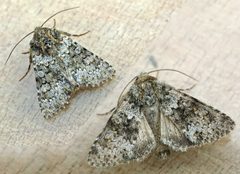
Hecatera dysodea, the Small Ranunculus, is a noctuid native to Central and Southern Europe, North Africa, and Central Asia. It has been introduced to North America, where it was first detected in Utah in 1998 and Oregon in 2005. The has experienced local extinction and recolonisation in Britain, where it disappeared by the 1930s and was rediscovered in Kent in 1997. are attracted to light and visit flowers, particularly of lettuce species.
Pronunciation
How to pronounce Hecatera dysodea: /ˈhɛkətɛrə dɪˈsoʊdiə/
These audio files are automatically generated. While they are not always 100% accurate, they are a good starting point.
Identification
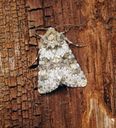
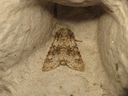
Distinguished from similar Hecatera by the combination of grey forewing ground color with orange-scaled markings, particularly the orange-spotted subterminal line. The pale to greenish-grey forewings with dark grey dusting and orange-accented lines separate it from H. bicolorata and related species. The two dark stigmata with orange scaling are diagnostic. In Britain, confusion most likely with H. bicolorata, which lacks the strong orange subterminal spotting and has more contrasting black-and-white forewing pattern.
Images
Habitat
Dry areas, brownfields, roadsides, embankments, gardens, and parks. Found at edges and open localities rather than closed vegetation. In the Alps, recorded up to 1400 m elevation.
Distribution
Native range: Central and Southern Europe from the Baltic Sea and southern Lithuania through Belarus and south of Moscow to the Urals; south to North Africa (Algeria, Morocco); east through the Middle East, Turkestan, and across the Palearctic to Central Asia (including Asia Minor, Persia, Syria, Kashmir, and China). Introduced to North America: first recorded Utah 1998, Oregon 2005, now widespread in the Pacific Northwest. In Britain, historically widespread with peak abundance late 19th century, extinct by 1930s, rediscovered Kent 1997, now widespread in England and parts of Wales.
Seasonality
on the wing from May to mid-August in Central Europe; two overlapping reported with period extending to October in some regions. Cocoons typically hatch in June when humidity increases.
Diet
Larvae feed on flowers and seeds of Asteraceae, specifically Lactuca including Prickly Lettuce (Lactuca serriola), other wild lettuce species, and cultivated lettuce varieties.
Host Associations
- Lactuca serriola - larval food plantPrickly Lettuce; primary
- Lactuca - larval food plant level; includes cultivated varieties
Life Cycle
Two overlapping reported (contrary to some sources stating one generation). stage not explicitly documented in available sources. in cocoon; cocoons hatch in June with increased humidity.
Behavior
visit flowers, particularly of lettuce . Strongly attracted to light. Larvae feed internally on flower and developing seeds.
Ecological Role
Seed of Asteraceae, particularly Lactuca. Potential pest of lettuce seed crops due to larval feeding on bolted lettuce flowers and seeds.
Human Relevance
Potential agricultural pest of lettuce seed production. Subject of conservation interest in Britain due to extinction-recolonisation history. sequenced (640.9 Mb assembly, 32 chromosomal pseudomolecules, 12,213 protein-coding genes).
Similar Taxa
- Hecatera bicolorataSimilar size and preference; distinguished by more contrasting black-and-white forewing pattern without strong orange subterminal spotting
- Hecatera cappaOverlapping distribution; H. dysodea distinguished by orange-scaled markings and greyer ground color
Misconceptions
Some sources report a single , but two overlapping generations have been documented. The name 'dysodea' has been interpreted as referring to 'ill-smelling' larvae, possibly alluding to the odor of bolting lettuce rather than an inherent larval smell.
More Details
Genomic Resources
sequenced from female specimen collected Tonbridge, UK; assembly 640.9 Mb scaffolded into 32 chromosomal pseudomolecules (30 plus Z and W ); 12,213 protein-coding genes identified.
Conservation Status in Britain
Classified as Least Concern following post-1997 recolonisation and range expansion.