
Papaipema furcata
Smith, 1899
Ash Shoot Borer Moth, ash tip borer
Papaipema furcata is a noctuid whose larvae bore into the twigs of ash trees (Fraxinus spp.) and box elder (Acer negundo). are active from late summer through autumn, with a wingspan of 33–49 mm. The ranges across eastern and central North America from Quebec to Georgia and west to Louisiana and Manitoba.
Pronunciation
How to pronounce Papaipema furcata: /ˌpæpaɪˈpiːmə fɜːrˈkeɪtə/
These audio files are automatically generated. While they are not always 100% accurate, they are a good starting point.
Identification
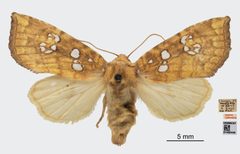
are difficult to distinguish from other Papaipema based on external appearance alone; genitalia examination is typically required for definitive identification. The combination of late-season period (August–October), association with ash or box elder , and geographic range may help narrow possibilities. Larval presence is indicated by bored twigs with extrusion.
Images
Appearance
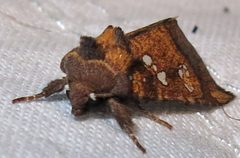
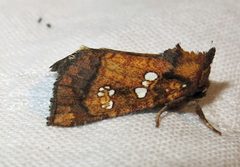
have a wingspan of 33–49 mm. As with other Papaipema , adults are relatively nondescript noctuid with cryptic coloration. Larvae are concealed within plant twigs and not readily observed.
Habitat
Deciduous woodlands and forests containing ash (Fraxinus) or box elder (Acer negundo). Larval is specifically the interior of plant twigs.
Distribution
Eastern and central North America: from Quebec and New Hampshire south to Georgia, west to Louisiana, and north to Manitoba and Saskatchewan.
Seasonality
are active from August to October. Larval development occurs within twigs, likely in this stage.
Diet
Larvae feed internally on the twigs of Fraxinus and Acer negundo. The specific feeding mechanism involves boring into twigs and consuming vascular tissues. feeding habits are not documented.
Host Associations
- Fraxinus - larval multiple
- Acer negundo - larval box elder
Life Cycle
are presumably laid on or near plants; specific oviposition is not documented. Larvae bore into twigs and develop internally, producing that may extrude from entry holes. likely occurs within the twig or in soil; specific details unconfirmed. emerge in late summer to autumn.
Behavior
are and attracted to light. Larvae are concealed feeders, boring into twigs and remaining hidden throughout development. Males and females are both capable of .
Ecological Role
As a twig-borer, larvae may cause localized dieback of plant shoots. levels are generally not sufficient to cause significant tree mortality, though heavy could theoretically impact host vigor.
Human Relevance
Minor economic significance; occasionally noted as a pest in ash plantings but not a major forestry concern. May be encountered by entomologists surveying late-season noctuid fauna.
Similar Taxa
- Other Papaipema speciesNumerous share similar and require genital dissection for separation; many also bore into plant stems but on different plants.
- Other Noctuidae stem borersExternal appearance of overlaps with many noctuids; larval habits and specificity are distinguishing features.
More Details
Taxonomic note
Originally described as Hydroecia furcata Smith, 1899; later transferred to Papaipema. The Papaipema is characterized by larvae that bore into plant stems, roots, or twigs of various plants.
Research potential
The specific mechanisms of selection and the extent of damage caused by larval feeding warrant further study, particularly given the ecological and economic importance of ash .
Sources and further reading
- BugGuide
- Wikipedia
- GBIF taxonomy match
- iNaturalist taxon
- NCBI Taxonomy
- Catalogue of Life
- Bodil Cass and 'The Curious Case of Katydids in California Citrus' | Bug Squad
- Bug Eric: Fork-tailed Bush Katydid
- 🪲 Entomologizing w/ the WGNSS Entomology Group at Hughes Mountain Natural Area — 11 Oct 2025 | Beetles In The Bush
- Bug Eric: Grand Finale