
Acronicta albarufa
Grote, 1874
Barrens dagger moth
Species Guides
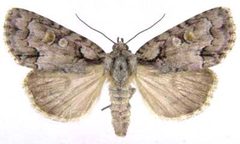
1Acronicta albarufa, the barrens dagger , is a noctuid moth with a fragmented distribution across North America. are typically 3.0–3.5 cm in length and active from June to August, with some producing a partial second . The is strongly associated with oak and pine barren , particularly pitch pine–bear oak in the Northeast and oak savannahs in the western and southern portions of its range. It is listed as a species of special concern in Connecticut and believed extirpated there.
Identification
The barrens dagger can be distinguished from other dagger moths (Acronicta spp.) by its strong association with sandy, xeric, open oak-dominated barren . Its fragmented distribution in specific barren helps separate it from more widespread Acronicta . Definitive species-level identification likely requires examination of genitalia or molecular analysis, as is common for many noctuid moths.
Images
Appearance
are typically 3.0–3.5 cm in length. Specific wing pattern and coloration details are not described in available sources.
Habitat
Sandy, xeric, open oak-dominated including pitch pine–bear oak (Pinus rigida–Quercus ilicifolia) forest and oak scrub in New England and southeastern New York; frost-bottom communities on Martha's Vineyard; black oak–post oak (Quercus velutina–Quercus stellata) woodland in New Jersey; oak savannahs and oak-hickory (Carya spp.) forests in the western and southern portions of the range. Occupied patches are typically larger than 2,000 acres (1,000 ha).
Distribution
Fragmented distribution in North America: southern Ontario, Manitoba, New York, New Jersey, Massachusetts, North Carolina, Virginia, Georgia, Oklahoma, Missouri, Arkansas, and Colorado. Possibly present in Ohio, Pennsylvania, Connecticut, mainland New York, and New Mexico. Believed extirpated from Connecticut. Southwestern U.S. may represent a separate .
Seasonality
typically active June to August; documented from late May to September in New Jersey and Missouri. laid July or August, hatching in about 6 days. Larvae present late June to September or October for 4–5 weeks (8–10 weeks for second- individuals). Pupae present fall through spring.
Diet
Larvae feed on bear oak (Quercus ilicifolia) and have been observed on post oak (Quercus stellata) and dwarf chinkapin oak (Quercus prinoides). Successfully raised on black oak (Quercus velutina) in captivity but rejected blackjack oak (Quercus marilandica). Bur oak (Quercus macrocarpa) is the only oak within the Manitoba range. likely consume honeydew from sucking insects and tree sap.
Host Associations
- Quercus ilicifolia - larval food plantprimary
- Quercus stellata - larval food plantobserved in nature
- Quercus prinoides - larval food plantobserved in nature
- Quercus velutina - larval food plantaccepted in captivity
- Quercus marilandica - larval food plantrejected in captivity
- Quercus macrocarpa - larval food plantonly oak in Manitoba portion of range
Life Cycle
Complete with one per year; partial second occurs in New Jersey and Missouri when laid in mid-June. Eggs laid July or August, hatch in ~6 days. Larval stage 4–5 weeks (8–10 weeks for second brood). occurs in fall in a flimsy cocoon in soil; pupae overwinter once and do not persist multiple winters. emerge over a 2-month period.
Behavior
. may disperse 1–2 miles (2–3 km) from suitable , suggesting considerable potential. Attracted to light.
Ecological Role
Herbivore in oak barren ; larvae consume oak foliage. Serves as potential for . Associated with early successional patches in pitch pine-bear oak .
Human Relevance
Subject to conservation concern due to loss and fragmentation. Listed as of special concern and believed extirpated in Connecticut. Habitat management including prescribed burns and selective thinning may benefit . Threatened by spraying for mosquitoes and .
Similar Taxa
- Other Acronicta speciesMany dagger moths share similar ; A. albarufa distinguished by specificity and distribution
- Acronicta americanaAmerican dagger moth is more widespread and associated with box elder and other rather than oak barrens
More Details
Conservation status
The multiple threats including loss, fire suppression, extensive fires, high white-tailed deer browsing, introduced species (gypsy moth, Compsilura concinnata), , off-road vehicles, and light pollution. White-tailed deer damage contributed to extirpation at Pinery Provincial Park, Ontario. Spring application of Bacillus thuringiensis var. kurstaki is recommended over other insecticides if gypsy moth control is necessary.
Taxonomic uncertainty
in the southwestern United States may represent a separate ; no definitive taxonomic revision has been completed.