
Acronicta americana
Harris, 1841
American dagger moth
Acronicta americana, the American dagger , is a North American noctuid moth with distinctive wing patterns and densely hairy caterpillars. Adults are active from April to September, with caterpillars present July through October. The inhabits deciduous woodlands and forests, where larvae feed on a broad range of hardwood trees. Caterpillar setae have been reported to cause skin irritation in humans, though without venom. The species shows geographic variation in number: one annually in northern , two to three in southern populations.
Pronunciation
How to pronounce Acronicta americana: //əˈkɹɒnɪktə əˌmɛɹɪˈkeɪnə//
These audio files are automatically generated. While they are not always 100% accurate, they are a good starting point.
Identification
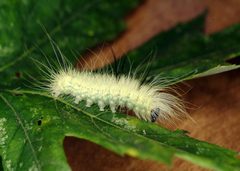
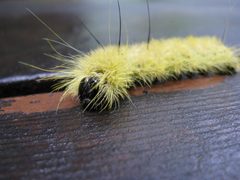
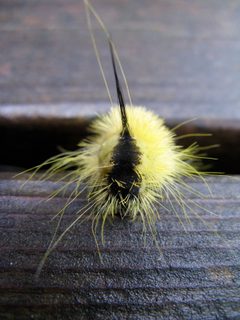
distinguished by sharp double postmedian line on forewing with white between, plus black dash on anal area. Sexes separable by hindwing coloration: male gray with faint line, female completely dark. Caterpillars recognized by dense yellow setae in early instars, pale yellow to white setae in later instars, with diagnostic black setal tuft on eighth abdominal segment and thin black setae on first and third abdominal segments.
Images
Habitat
Deciduous woodlands and forests.
Distribution
North America east of the Rocky Mountains. Recorded from Canada (Alberta, Manitoba, Saskatchewan) and United States (including Vermont).
Seasonality
: April to September throughout range. Caterpillars: July to October. One annually in northern ; two to three broods in southern populations.
Diet
Larvae feed on leaves of diverse hardwood trees: maple (Acer spp., including Acer negundo), horse chestnut (Aesculus hippocastanum), alder (Alnus spp.), birch (Betula spp.), American hornbeam (Carpinus caroliniana), hickory (Carya spp.), chestnut (Castanea spp.), redbud (Cercis spp.), hazel (Corylus spp.), ash (Fraxinus spp.), walnut (Juglans spp.), sycamore (Platanus spp.), poplar (Populus spp.), oak (Quercus spp.), willow (Salix spp.), basswood (Tilia spp.), and elm (Ulmus spp.). diet not specified in sources.
Life Cycle
Complete . deposited on foliage. Larva passes through multiple instars, changing from densely yellow-setose young form to paler, less setose older form. presumably in soil or leaf litter (specific details not documented in sources). timed for spring through late summer depending on latitude and number.
Behavior
, attracted to light. Larvae feed externally on leaves.
Ecological Role
Herbivore in deciduous forest . Larval defoliation of diverse hardwood tree ; specific ecological impacts not quantified in sources.
Human Relevance
Caterpillar setae have been reported to cause skin irritation in humans, though sources explicitly note no evidence of venom. Occasionally encountered in residential areas where trees are present.
Misconceptions
Despite reports of skin irritation from caterpillar contact, the does not possess venom—a distinction sometimes misunderstood by the public.
Sources and further reading
- BugGuide
- Wikipedia
- GBIF taxonomy match
- iNaturalist taxon
- NCBI Taxonomy
- Catalogue of Life
- Bug Eric: New Mexico Dragonfly Blitz - Day 4
- Bug Eric: December 2015
- Deerly departed: food for flesh-recycling carrion beetles - Margined carrion beetle, Oiceoptoma noveboracense, and American carrion beetle, Necrophila americana — Bug of the Week
- Megalopygidae | Beetles In The Bush
- As a Watershed is Urbanized, Damselflies Show Declines
- Silphidae | Beetles In The Bush