
Hypena sordidula
Grote, 1872
Sordid Hypena, Sordid Bomolocha Moth, Sordid Snout
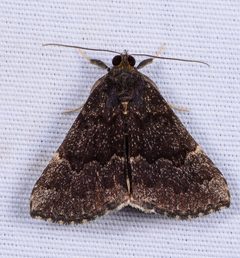
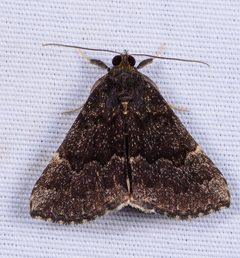
Hypena sordidula, the Sordid Hypena or Sordid Bomolocha , is a small moth in the Erebidae described by Augustus Radcliffe Grote in 1872. It is distributed across eastern and central North America, with active from May through August and two per year. The is notable for its specialized larval association with Laportea species, and for historical confusion regarding its plant relationships.
Pronunciation
How to pronounce Hypena sordidula: /haɪˈpiːnə sɔːrˈdɪdjuːlə/
These audio files are automatically generated. While they are not always 100% accurate, they are a good starting point.
Identification
The Sordid Hypena can be distinguished from other Hypena by its small size (24–30 mm wingspan), dull brownish-gray coloration, and relatively subdued wing patterning. It is smaller than many and lacks strong contrasting markings. The snout-like palps are shared with all Hypena species and thus not diagnostic at the species level. Accurate identification often requires examination of genitalia or association with plants. It may be confused with other small, dull-colored noctuoid , particularly other Hypena species, but its specific combination of size, color, and distribution helps separate it. The period (May–August, two ) and larval association with Laportea are supporting identification clues where host plants are present.
Images
Habitat
Associated with supporting its larval plants, Laportea (wood-nettle relatives). These are typically moist, shaded environments such as woodland edges, riparian areas, and disturbed moist sites. The has been recorded in both forested and semi-open situations within its range. are attracted to artificial light sources.
Distribution
Eastern and central North America: from Quebec and Maine south to northern Florida and Texas, west to Louisiana and Kansas, north to Manitoba and Saskatchewan. Records also include Vermont. The occupies the eastern deciduous forest biome and adjacent grassland-forest transition zones.
Seasonality
fly from May to August. Two occur per year, with peak activity distributed across this period. The pattern is consistent across the range, though exact timing may vary with latitude.
Diet
Larvae feed on Laportea (wood-nettle relatives in the Urticaceae). Historical reports of alder and butternut as have been determined to be incorrect.
Host Associations
- Laportea - larval food plantSpecific Laportea not identified in sources
Life Cycle
: two per year. present May through August. Larval development occurs on Laportea plants. Specific details of placement, larval instars, sites, and stage are not documented in available sources.
Behavior
are and attracted to artificial light sources. Larval feeding on Laportea has not been described in detail. The exhibits the typical behavior of flying with orientation to celestial cues, which causes disorientation around artificial lights.
Ecological Role
As a herbivore on Laportea, the contributes to nutrient cycling in moist woodland and riparian . Its role in as prey for has not been quantified. The Hypena includes species that are significant agricultural pests, but H. sordidula is not among them.
Human Relevance
Minimal direct economic or agricultural impact. The is not reported as a pest of crops or ornamental plants. It is of interest to lepidopterists and naturalists, particularly for its specialized plant association. Historical misidentification of host plants (alder, butternut) suggests past confusion with other species or erroneous rearing records.
Similar Taxa
- Hypena scabraGreen Cloverworm Moth; larger, more abundant, on legumes and other plants including soybean; three or more per year; more contrasting wing pattern with distinct lines
- Other Hypena speciesMany share the snout-like palps and general body form; H. sordidula distinguished by small size, dull coloration, specific distribution, and Laportea association
Misconceptions
Two reported plants, alder (Alnus) and butternut (Juglans cinerea), are incorrect. These erroneous records likely resulted from misidentification of larvae or confusion with other Hypena . The true host plants are Laportea species in the Urticaceae.
More Details
Taxonomic Note
The was originally described by Augustus Radcliffe Grote in 1872. The placement has been updated from Noctuidae to Erebidae ( Hypeninae) based on modern phylogenetic studies.
Nomenclatural Clarification
The 'Sordid Bomolocha ' reflects an older classification; Bomolocha was formerly used as a name for some Hypena but is now treated as a synonym of Hypena.
Sources and further reading
- BugGuide
- Wikipedia
- GBIF taxonomy match
- iNaturalist taxon
- NCBI Taxonomy
- Catalogue of Life
- Soybean Insects: Mid-to-Late Season Pests (V8 to Maturity) - AgriLife Extension Entomology
- green cloverworm (Hypena scabra) - Entomology Today
- A Revision of Soybean Caterpillar Pest Information for U.S. Soybean
- Bug Eric: National Moth Week 2024 Recap from Kansas City
- Bug Eric: Blacklighting Already?
- caterpillar pests of soybean - Entomology Today