
Catocala violenta
Edwards, H., 1880
Pronunciation
How to pronounce Catocala violenta: /ˌkætəˈkeɪlə viːəˈlɛntə/
These audio files are automatically generated. While they are not always 100% accurate, they are a good starting point.
Identification
Distinguished from other Catocala by geographic range and association with Quercus gambeli as larval . are active July–August. Specific wing patterns and genitalia would be required for definitive identification; dissection is typically necessary for accurate species-level determination in this .
Images
Appearance
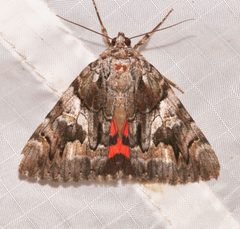
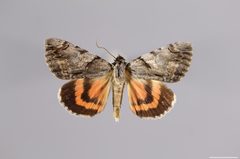
have a wingspan of 70–80 mm. Like other underwing moths, the forewings are cryptically colored to blend with tree bark when at rest, concealing the more vividly patterned hindwings. The specific coloration pattern of C. violenta is not described in available sources.
Habitat
Associated with oak woodland and mixed conifer-oak forest where the larval plant Quercus gambeli (Gambel's oak) occurs. Elevation records include 7,000 feet in dry, mixed conifer forest with oaks in New Mexico.
Distribution
Southwestern North America: from Colorado south to Arizona, east to Texas, and extending into Mexico. Distribution closely tracks the range of its larval plant.
Seasonality
are on wing from July to August, with timing varying by location. One per year ().
Diet
Larvae feed exclusively on Quercus gambeli (Gambel's oak). feeding habits are not documented.
Host Associations
- Quercus gambeli - larval plantGambel's oak; sole documented food plant
Life Cycle
Complete with one annually. Larvae feed on oak foliage; presumably occurs in soil or leaf litter, though specific details are unreported. emerge mid-summer.
Behavior
are . Like other underwing moths, they typically rest with forewings folded over the , concealing the brightly colored hindwings. When disturbed, they flash the hindwings to startle before taking . At light traps, they often remain on the periphery rather than landing directly on the sheet.
Ecological Role
Larvae function as folivores on Gambel's oak, contributing to nutrient cycling in oak woodland . likely serve as prey for including bats, birds, and spiders. The specific ecological role of this has not been studied.
Human Relevance
No direct economic or cultural significance documented. Like other underwing moths, it may be encountered during insect surveys and -watching events.
Similar Taxa
- Catocala aholibahLarger underwing with overlapping range in Colorado; distinguished by size and specific wing patterns
- Catocala verillianaSmaller underwing sympatric in Colorado; separated by size and wing characteristics
- Other Catocala speciesMany in share cryptic forewings and colorful hindwings; accurate identification requires examination of genitalia or detailed wing pattern analysis
More Details
Taxonomic placement
Historically placed in Noctuidae; now classified in Erebidae following molecular phylogenetic revisions of Lepidoptera.
Collection records
The is represented by relatively few documented observations (48 records on iNaturalist as of source date), suggesting it may be genuinely uncommon or underreported due to habits and identification challenges.
Sources and further reading
- BugGuide
- Wikipedia
- GBIF taxonomy match
- iNaturalist taxon
- NCBI Taxonomy
- Catalogue of Life
- A Gathering of Lepidopterists: Who's Who of the Butterfly, Moth Experts | Bug Squad
- Got Moths? Celebrate National Moth Week and Global Citizen Science
- Bug Eric: National Moth Week Recap, 2015
- Bug Eric: National Moth Week Recap for Colorado Springs
- Bug Eric: National Moth Week 2024 Recap from Kansas City
- Bug Eric: New Mexico Night Bugs