
Catocala piatrix
Grote, 1864
Penitent Underwing
Species Guides
1Catocala piatrix, commonly known as the Penitent Underwing, is a medium-sized underwing native to North America. are recognized by their dark forewings that conceal bright yellow-orange hindwings marked with two concentric black bands. The was first described by Augustus Radcliffe Grote in 1864 and belongs to the Catocala, which contains over 250 species known for their strikingly colored hindwings. Two are recognized: the nominate C. p. piatrix in the eastern United States and C. p. dionyza in Arizona.
Pronunciation
How to pronounce Catocala piatrix: /ˈkætəkələ ˈpaɪətrɪks/
These audio files are automatically generated. While they are not always 100% accurate, they are a good starting point.
Identification
Distinguished from other yellow-orange banded underwings by the wide, relatively smooth-edged yellow zone between the two black hindwing bands. The oblique lighter forewing band is also diagnostic. Similar include other Catocala with yellow-orange hindwings, but C. piatrix lacks the prominent dark basal hair tuft seen in some relatives and has a characteristic band pattern. Spiny tibiae and help distinguish it from non-hickory-feeding Catocala species.
Images
Appearance
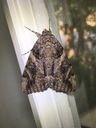
have a wingspan of 70–80 mm. Forewings are dark brownish gray, darkest at the base, with an oblique lighter band extending from midwing to the leading edge near the wing base. Hindwings are yellow-orange with dark hairs at the base and two concentric black bands; the yellow zone between the bands is wide with a relatively smooth edge. The outer edge of the hindwings is light yellow with some black bars extending from the outer band. Both foreleg and hindleg tibiae are spiny, with bearing four rows of irregular spines each—a trait typical of hickory-feeding Catocala .
Habitat
Associated with deciduous forests containing trees including hickory, walnut, ash, and pecan. The nominate occupies eastern deciduous woodlands, while C. p. dionyza occurs in Arizona, suggesting adaptability to varied forest types within its range.
Distribution
North America. The nominate Catocala piatrix piatrix occurs in the eastern United States. Subspecies Catocala piatrix dionyza is found in Arizona. Records exist from Vermont and throughout the eastern and southwestern United States.
Seasonality
fly from July to November, with timing varying by location. This extended period suggests a single with prolonged or possible partial second generation in southern portions of the range.
Diet
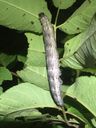
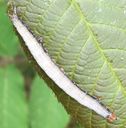
Larvae feed on leaves of ash (Fraxinus), butternut (Juglans cinerea), hickory (Carya), pecan (Carya illinoinensis), persimmon (Diospyros), and walnut (Juglans). feeding habits are not documented.
Host Associations
- Fraxinus - larval ash
- Juglans cinerea - larval butternut
- Carya - larval hickory
- Carya illinoinensis - larval pecan
- Diospyros - larval persimmon
- Juglans - larval walnut
Life Cycle
Complete with , larva, pupa, and stages. Larvae are folivores on the specified trees. likely occurs in soil or leaf litter, as is typical for the , though specific details are not documented. Adults emerge in mid-summer to late autumn.
Behavior
are and have been observed at light stations, though they typically remain on the periphery rather than landing directly on sheets. When disturbed, they may flash their brightly colored hindwings as a startle defense before taking . This , common in the Catocala, momentarily surprises potential , allowing escape.
Ecological Role
Larvae function as folivores in deciduous forest , consuming leaves of various hardwood trees. may serve as prey for including bats and birds. Their role as , if any, is undocumented. The contributes to nutrient cycling through larval feeding and subsequent deposition of .
Human Relevance
Subject of interest to lepidopterists and citizen scientists during National Week and similar events. The is not considered an economic pest. Its striking hindwing coloration makes it a popular photographic subject among moth enthusiasts. No documented cultural or traditional uses.
Similar Taxa
- Catocala concumbensAlso has yellow-orange hindwings with black bands, but differs in band width and pattern details; forewing pattern also distinct
- Catocala epioneYellow-orange banded underwing with similar size, but hindwing band pattern and forewing markings differ
- Other hickory-feeding CatocalaShare spiny leg characteristics but differ in hindwing color (some have red or pink bands) and precise band pattern
More Details
Subspecies
Two recognized: Catocala piatrix piatrix (eastern US) and Catocala piatrix dionyza (Arizona, described by H. Edwards in 1884). The subspecific distinction reflects geographic variation in this widespread .
Taxonomic placement
placement varies by classification system: treated as Noctuidae in broader circumscriptions or Erebidae in stricter modern treatments. Currently placed in Erebidae: Erebinae: Catocalini by most contemporary authorities.
Sources and further reading
- BugGuide
- Wikipedia
- GBIF taxonomy match
- iNaturalist taxon
- NCBI Taxonomy
- Catalogue of Life
- A Gathering of Lepidopterists: Who's Who of the Butterfly, Moth Experts | Bug Squad
- Got Moths? Celebrate National Moth Week and Global Citizen Science
- Bug Eric: National Moth Week Recap, 2015
- Bug Eric: National Moth Week Recap for Colorado Springs
- Bug Eric: National Moth Week 2024 Recap from Kansas City
- Bug Eric: New Mexico Night Bugs