
Calyptra canadensis
Bethune, 1865
Canadian owlet, meadow rue owlet moth
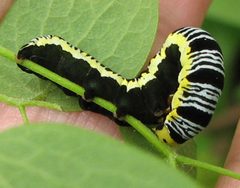
Calyptra canadensis, known as the Canadian owlet or meadow rue , is a North American in the Erebidae. It is the only member of the Calyptra found in the New World; all other 16 occur in the Old World. feed on fruit by piercing the skin to access juices. The species is notable for its modified for piercing, though unlike some related Old World species, blood-feeding has not been documented in C. canadensis.
Pronunciation
How to pronounce Calyptra canadensis: /kəˈlɪp.trə ˌkæn.əˈdɛn.sɪs/
These audio files are automatically generated. While they are not always 100% accurate, they are a good starting point.
Identification
Distinguished from other North American owlet moths by the combination of: fruit-piercing with visible lateral hooks when examined closely; moderate size (wingspan 33–40 mm); and geographic range. The only congeneric in North America, eliminating confusion with other Calyptra species. Similar-sized fruit-piercing moths in other (e.g., some Noctuidae) lack the specific proboscis armature of Calyptra. Accurate identification may require examination of genitalia or reference to specialized lepidopteran keys.
Images
Appearance
have a wingspan of 33–40 mm. The forewings are typically brownish with variable patterning. The is modified for piercing, with lateral hooks that can be deployed to anchor the proboscis in substrate. The are . Coloration and pattern details are variable and not well-documented in available sources.
Habitat
Found in diverse across its broad North American range, including deciduous and mixed forests, woodland edges, meadows, and suburban areas. Associated with habitats supporting its larval plants (Thalictrum ) and fruit sources for . Elevation records include mountainous regions in the southern Appalachians.
Distribution
to North America. Range extends from Nova Scotia south through the Appalachians to North Carolina, westward through the Great Plains to Texas, and north to Saskatchewan. Occasional records from Alberta represent strays outside the core range. The only Calyptra occurring in the New World.
Seasonality
are active from June to September, with exact timing varying by latitude and local climate. In more northern portions of the range, activity is concentrated in mid-summer; southern may show extended or earlier periods.
Diet
feed on fruit by piercing the skin with their modified and sucking juices. In laboratory settings, adults have been observed piercing strawberries. Larvae feed on leaves of Thalictrum (meadow-rues), specifically documented on Thalictrum revolutum and likely other .
Host Associations
- Thalictrum - larval specifically Thalictrum revolutum and other Thalictrum
- various fruits - food source pierce fruit skin to feed on juices; strawberries observed in lab
Life Cycle
Complete with four stages: , larva, pupa, . Larvae feed on Thalictrum leaves. occurs in soil or leaf litter. Adults emerge in summer. Specific details of egg deposition, larval instars, and stage are not well-documented in published sources.
Behavior
are and attracted to light. When feeding on fruit, adults use a rocking motion of the to penetrate the skin, then deploy lateral hooks to anchor the proboscis while feeding. Blood-feeding, observed in some Old World Calyptra , has not been documented in C. canadensis despite close morphological similarity.
Ecological Role
Larvae function as herbivores on Thalictrum . may contribute to nutrient cycling through fruit feeding, though their ecological impact is minor. Potential role as while visiting flowers for nectar is unstudied. No documented parasitic or predatory relationships.
Human Relevance
Minimal direct economic impact. Not known to be a significant agricultural pest. Of scientific interest due to its unique status as the only New World representative of a containing vampire moths. Occasionally encountered by lepidopterists and naturalists at light traps.
Similar Taxa
- Old World Calyptra species (e.g., C. thalictri, C. fletcheri)Similar and fruit-piercing ; distinguished by geographic distribution (Asia, Africa, Europe) and in some cases documented blood-feeding behavior in males
- Other Calpinae mothsShare characteristics; distinguished by structure, associations, and detailed morphological features requiring examination
- Noctuidae fruit-piercing mothsSimilar feeding on fruit; distinguished by -level characters including wing venation and structure
More Details
Vampire moth connection
While C. canadensis possesses the piercing characteristic of the , it has not been observed feeding on blood. All documented blood-feeding in Calyptra involves Old World . Whether C. canadensis is physiologically capable of blood-feeding or simply lacks the remains unknown.
Taxonomic history
Originally described as Calpe canadensis by Bethune in 1865. The name Calpe was preoccupied, leading to current placement in Calyptra. The ' unusual distribution pattern—solitary New World representative of an otherwise Old World genus—has attracted biogeographic interest.
Sources and further reading
- BugGuide
- Wikipedia
- GBIF taxonomy match
- iNaturalist taxon
- NCBI Taxonomy
- Catalogue of Life
- Vampire Moths Suck the Blood of Vertebrates, Including Humans
- T.G.I.Flyday: Tachinomyia sp. | Beetles In The Bush
- Super Crop Challenge #4 | Beetles In The Bush
- Bug Eric: Spider Sunday: Red Velvet Jumper
- Bug Eric: True Bug Tuesday: Mirid plant bug