
Calyptra
Vampire Moths, Fruit-piercing Moths
Species Guides
1- Calyptra canadensis(Canadian owlet)
Calyptra is a of comprising approximately 18 , commonly known as vampire moths or fruit-piercing moths. Both sexes possess a modified with heavily sclerotized, barbed hooks that enables piercing of fruit skins to feed on juices. Males of at least 10 species have been documented piercing mammalian skin to feed on blood, a facultative not observed in females. The genus occurs primarily in the Old World, with one species (C. canadensis) in North America. The blood-feeding behavior is hypothesized to have evolved from ancestral fruit-piercing, with males possibly obtaining salts or to transfer to females during mating.
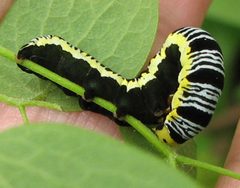
Pronunciation
How to pronounce Calyptra: //kəˈlɪptɹə//
These audio files are automatically generated. While they are not always 100% accurate, they are a good starting point.
Identification
The is distinguished from other Calpini by the combination of fruit-piercing and, in males of , documented blood-feeding . The proboscis structure with heavily sclerotized, barbed hooks is diagnostic for the genus. Species-level identification requires examination of genitalia and wing venation patterns; C. thalictri and C. fletcheri have been studied most extensively. C. canadensis is the only New World species and is probably not hematophagous. The presence of a visible or frontal mentioned in some sources appears to be a misapplication of dipteran terminology and should not be used for identification.
Images
Appearance
Wingspan ranges from 35–72 mm across . The is highly modified for piercing: heavily sclerotized with barbed hooks on the sides that anchor into tissue during feeding. When not in use, the proboscis is coiled beneath the . The proboscis structure includes two parts that move in antiparallel fashion, alternating between anchoring and drilling. General body plan typical of Calpinae , with robust and relatively broad wings.
Habitat
Subtropical and tropical regions of the Old World, extending into temperate East Asia. include forests, agricultural areas, and human-modified landscapes where fruits are available. One (C. canadensis) occurs in temperate North American deciduous forests. Specific microhabitat preferences vary by species; some are associated with particular host plants.
Distribution
Eastern and southern Europe, Ukraine, Central Asia, Kazakhstan, Mongolia, Russian Far East, China (seven confirmed : Sichuan, Zhejiang, Fujian, Hainan, Xinjiang, Hubei, Hunan, Ningxia, Hebei), Korea, Japan, Southeast Asia, India, sub-Himalayan South Asia, eastern Africa, Middle East, North Africa. Single species in North America: C. canadensis in Canada and the United States.
Seasonality
activity patterns vary by and latitude. C. canadensis active in summer months in temperate North America. Tropical and subtropical species likely active during warmer periods when fruits are available. Specific data not comprehensively documented.
Diet
Both sexes: fruit juices from soft-skinned fruits (Rubus, Vitis) and thicker-skinned fruits (Ficus, Citrus). Males of 10 : mammalian blood (facultative, not obligate). Blood-feeding duration up to 50 minutes has been observed. Females do not feed on blood. Larvae feed on leaves of plants.
Host Associations
- Stephania spp. (Menispermaceae) - larval plantDocumented for C. gruesa
- Thalictrum spp. (Ranunculaceae) - larval plantDocumented for C. thalictri; name source for epithet
- Rubus spp. (Rosaceae) - food sourceSoft-skinned fruit pierced by both sexes
- Vitis spp. (Vitaceae) - food sourceSoft-skinned fruit pierced by both sexes
- Ficus spp. (Moraceae) - food sourceThicker-skinned fruit pierced by both sexes
- Citrus spp. (Rutaceae) - food sourceThicker-skinned fruit pierced by both sexes
Life Cycle
Complete (, larva, pupa, ). Larvae are leaf-feeders on specific plants. occurs in soil or leaf litter. Adults emerge with fully developed piercing . Specific details on egg laying, larval instars, and pupal duration not documented in available sources.
Behavior
Males of locate mammalian by unknown cues, land on exposed skin, and initiate piercing by rocking the back and forth to penetrate the skin. Once penetrated, oscillating movements drive the proboscis deeper; barbed hooks anchor the proboscis as blood wells up. Both sexes pierce fruits using similar mechanical actions. Blood-feeding does not extend male lifespan but may enhance through nutrient transfer to females. C. thalictri and C. fasciata show geographic variation in feeding , with some not exhibiting . C. fletcheri and C. thalictri have only shown blood-feeding under experimental or semi-natural conditions, suggesting laboratory-induced or geographically restricted behavior.
Ecological Role
are significant fruit pests in South and Southeast Asia, causing damage to agricultural crops including citrus, figs, grapes, and berries. The piercing damage creates entry points for fungal and accelerates fruit decay. Larvae function as herbivores on specific plants. Blood-feeding males may serve as minor of mammals, though ecological impact is negligible compared to dipterans.
Human Relevance
Agricultural pest status due to fruit damage in Asia. Bites to humans cause localized red, sore reactions but are not considered medically dangerous. Research interest in the evolution of from . Subject of scientific study by Dr. Jennifer Zaspel at Purdue University regarding molecular and feeding structure evolution.
Similar Taxa
- Other Calpini generaShare Calpinae and fruit-piercing , but lack the heavily sclerotized, barbed proboscis hooks and documented blood-feeding of Calyptra
- Noctuidae fruit-piercing mothsSome noctuids pierce fruit, but structure differs and blood-feeding is not documented
- Diptera (flies)Superficially similar with aristate and ocellar triangle in some sources, but Calyptra is Lepidoptera with scaled wings and complete ; confusion arises from convergent piercing mouthpart adaptations
Misconceptions
The 'vampire ' suggests obligate blood-feeding, but is facultative and restricted to males of certain . C. canadensis, the North American species, has not been documented feeding on blood despite the common name association. Some sources incorrectly apply dipteran terminology (, frontal ) to moth . The was historically confused with or synonymized under other calpine genera, and species-level remains under revision.
More Details
Evolution of Hematophagy
Blood-feeding in Calyptra is hypothesized to have evolved from ancestral fruit-piercing , representing a rare case of transition from plant-associated to animal-associated feeding. The modifications for piercing fruit skin pre-adapted males for penetrating mammalian skin. This evolutionary trajectory is being studied through molecular and comparative .
Taxonomic Uncertainty
The number of valid has fluctuated between 17 and 18 in recent literature. A 2025 taxonomic revision of Chinese fauna confirmed seven species, down from ten previously reported, indicating ongoing taxonomic refinement. The tribe Calpini, which contains Calyptra, has uncertain circumscription with multiple of fruit-piercing and -frequenting .
Research Methods
Documentation of blood-feeding has relied heavily on laboratory and semi-natural conditions (mesh cages, vials with human volunteers). Only eight have been confirmed feeding on mammals in the wild, raising questions about the natural frequency and ecological significance of versus laboratory artifact.
Sources and further reading
- BugGuide
- iNaturalist taxon
- NCBI Taxonomy
- Catalogue of Life
- Vampire Moths Suck the Blood of Vertebrates, Including Humans
- T.G.I.Flyday: Tachinomyia sp. | Beetles In The Bush
- Super Crop Challenge #4 | Beetles In The Bush
- Two striking new species of carnivorous plants discovered in the Andes of Ecuador | Blog
- Monday Moth – Trichaeta pterophorina | Beetles In The Bush
- Calyptranema fuscum gen. sp. nov.: a novel cyanobacterial genus within Oculatellaceae based on polyphasic and genomic characterization.
- Taxonomic Revision of Vampire Moths of the Genus Calyptra (Lepidoptera: Erebidae: Calpinae) in Chinese Fauna.