
Cremastobombycia solidaginis
(Frey & Boll, 1876)
Goldenrod Leafminer
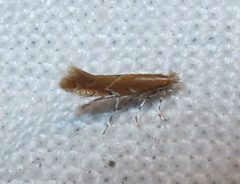
Cremastobombycia solidaginis is a microlepidopteran in the Gracillariidae, commonly known as the Goldenrod Leafminer. The is distributed across eastern North America from Ontario and Quebec south to Florida and Texas. Larvae feed internally in leaves of goldenrod (Solidago) species and Baccharis pilularis, creating characteristic mines. are small with a wingspan of 7–9 mm.
Pronunciation
How to pronounce Cremastobombycia solidaginis: //krɛˌmæstoʊbɒmˈbɪsiə ˌsɒlɪˈdeɪdʒɪnɪs//
These audio files are automatically generated. While they are not always 100% accurate, they are a good starting point.
Identification
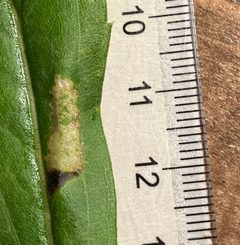
Distinguished from other Cremastobombycia by association with Solidago and Baccharis, and by geographic range. Distinguished from the goldenrod gall fly (Eurosta solidaginis) and goldenrod gall moth (Gnorimoschema gallaesolidaginis) by its leaf-mining habit rather than stem gall formation. Mines appear as pale, winding trails or blotches on goldenrod leaves. require genitalia examination or molecular analysis for definitive species identification within the .
Images
Appearance
Small with wingspan 7–9 mm. As a member of Gracillariidae, likely have narrow, wings with reduced venation typical of the . Coloration not explicitly described in sources; members of this often exhibit mottled or streaked patterns of brown, white, and yellow. . Larvae are internal leaf miners, not externally visible until mature.
Habitat
Associated with supporting plants: meadows, fields, roadsides, and disturbed areas where goldenrod (Solidago) and coyote brush (Baccharis pilularis) occur. Found in both natural and semi-urban environments across its range.
Distribution
Eastern North America: Canada (Ontario, Quebec); United States (Connecticut, Florida, Georgia, Kentucky, Maine, Maryland, Massachusetts, Michigan, Texas). GBIF records confirm presence in these jurisdictions.
Diet
Larvae feed internally in leaves of Solidago (including S. altissima, S. bicolor, S. caesia, S. canadensis, S. fistulosa, S. gigantea, S. patula, S. rugosa) and Baccharis pilularis. Feeding occurs as leaf mining, not gall formation. feeding habits unknown.
Host Associations
- Solidago altissima - larval leaf mining
- Solidago bicolor - larval leaf mining
- Solidago caesia - larval leaf mining
- Solidago canadensis - larval leaf mining
- Solidago fistulosa - larval leaf mining
- Solidago gigantea - larval leaf mining
- Solidago patula - larval leaf mining
- Solidago rugosa - larval leaf mining
- Baccharis pilularis - larval leaf mining
Behavior
Larvae are internal leaf miners, feeding between upper and lower leaf and creating visible mines. This represents a different feeding strategy from the stem-galling insects (Eurosta solidaginis, Gnorimoschema gallaesolidaginis) that are frequently associated with the same plants.
Ecological Role
As a , larvae alter leaf tissue and may affect photosynthetic capacity of plants. Specific ecological impacts not quantified in available literature. Part of the diverse herbivore associated with goldenrod, which supports complex including and .
Human Relevance
Not a significant agricultural or forestry pest. plants are primarily wild of goldenrod and coyote brush rather than cultivated crops. No documented economic impact.
Similar Taxa
- Eurosta solidaginisAlso associated with Solidago, but induces spherical stem galls rather than leaf mines; a fly (Diptera: Tephritidae), not a
- Gnorimoschema gallaesolidaginisAlso associated with Solidago, but induces elongate stem galls rather than leaf mines; in Gelechiidae
- Other Cremastobombycia speciesCongeneric may overlap in range and require genitalia dissection or molecular markers for definitive identification
More Details
Pollution detection research context
Research on using insect-induced plant galls as pollution detectors (phytoscreening) has focused on gall-forming insects such as Eurosta solidaginis and Gnorimoschema gallaesolidaginis, not on leaf miners like C. solidaginis. The leaf-mining habit of C. solidaginis differs fundamentally from gall formation; galls are discrete, nutrient-rich structures that accumulate contaminants at higher concentrations than surrounding plant tissue, whereas leaf mines are feeding tracks that do not appear to concentrate pollutants in the same manner.
Sources and further reading
- BugGuide
- Wikipedia
- GBIF taxonomy match
- iNaturalist taxon
- NCBI Taxonomy
- Catalogue of Life
- Unforeseen Trophic Interactions in Ag Systems: What-Eats-What in the Food Chain | Bug Squad
- Eurosta-solidaginis - Entomology Today
- Eurosta solidaginis Archives - Entomology Today
- How Some Insects Turn Plants Into Pollution Detectors
- Rare Form of Fat Allows Flies to Survive at -80° Celsius
- goldenrod gall - Entomology Today