
Epiblema scudderiana
(Clemens, 1860)
goldenrod gall moth
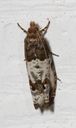
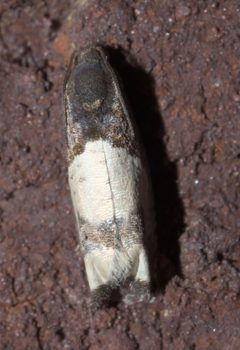
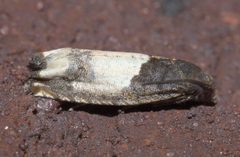
Epiblema scudderiana, commonly known as the goldenrod gall , is a tortricid moth whose larvae form elliptical galls on goldenrod stems. The is freeze-avoiding, surviving winter through deep supercooling of body fluids and accumulation of glycerol as a cryoprotectant. Larvae overwinter in within silk-lined galls, exhibiting dramatic metabolic suppression and epigenetic regulation of during cold stress. This moth has been extensively studied as a model for insect cold hardiness physiology, contrasting with the freeze-tolerant strategy of the sympatric gall fly Eurosta solidaginis.
Pronunciation
How to pronounce Epiblema scudderiana: /ɛpɪˈbluːmə skʌdɛriˈænə/
These audio files are automatically generated. While they are not always 100% accurate, they are a good starting point.
Images
Habitat
Larvae develop within elliptical galls on stems of goldenrod plants (Solidago canadensis and related Solidago ). The galls provide protected microhabitats for . have been observed at light stations in prairie and montane environments, including cottonwood groves with nearby wetlands.
Distribution
North America: recorded from Canada (Manitoba, Ontario, Saskatchewan) and the United States (Vermont, Colorado). Specific collection localities include fields around Ottawa, Ontario (approximately 45.41°N, 75.67°W) and El Paso County, Colorado.
Seasonality
Larvae overwinter in galls from autumn through spring, entering during winter months. occurs in spring. active during summer months; observed at light stations in late July in Colorado.
Host Associations
- Solidago canadensis - gall plantPrimary ; larvae form elliptical stem galls
- Solidago - gall plant-level association with goldenrod
Life Cycle
Larval stage overwinters within goldenrod stem galls. Prior to , larvae line gall interiors with silk. activity profiles shift seasonally: glycerol-3-phosphate dehydrogenase peaks in autumn for cryoprotectant synthesis; oxidase activity is suppressed during winter metabolic depression; lactate dehydrogenase increases in spring, preparing for . Spring clearance of glycerol cryoprotectant occurs via polyol dehydrogenase and glyceraldehyde kinase, with increasing fructose-bisphosphatase activity supporting gluconeogenic potential for cryoprotectant removal.
Behavior
Freeze-avoiding strategy employing deep supercooling of body fluids. Strong suppression of metabolic rate during . Epigenetic regulation via reduced histone lysine methylation and histone acetylation under cold stress (5°C to −15°C). phosphorylase activation in fall supplies carbon for glycerol synthesis from glycogen reserves. Hexose monophosphate shunt activity remains elevated to supply NAD(P)H for glycerol synthesis.
Ecological Role
Gall former on goldenrod stems; creates distinct elliptical galls on Solidago . The galls may provide or food resources for other organisms, though specific interactions are not documented in available sources.
Human Relevance
Subject of extensive physiological research on insect cold hardiness, freeze avoidance, and epigenetic regulation of metabolic suppression. Serves as a comparative model alongside the freeze-tolerant gall fly Eurosta solidaginis for understanding alternative strategies.
Similar Taxa
- Eurosta solidaginisSympatric gall former on goldenrod stems, but a dipteran (gall fly) rather than lepidopteran; employs freeze-tolerant strategy rather than freeze-avoiding strategy, making the pair a classic comparison for studying alternative cold hardiness mechanisms.
- Epiblema tripartitanaCongeneric tortricid with similar appearance and ; mentioned in same regional fauna surveys and can be confused without close examination.
More Details
Cryoprotectant biochemistry
Larvae accumulate glycerol concentrations up to approximately 2 M as a cryoprotectant, among the highest reported for freeze-avoiding insects. Two biosynthetic contribute: (1) glyceraldehyde-phosphate → glyceraldehyde → glycerol via glyceraldehyde phosphatase and NADPH-linked polyol dehydrogenase, and (2) dihydroxyacetone-phosphate → glycerol-3-phosphate → glycerol via glycerol-3-phosphate dehydrogenase and glycerol-3-phosphatase.
Epigenetic cold response
Under experimental cold stress, larvae show significant downregulation of lysine methyltransferases (ASH2L, SUV39H1, SETD7, SETD8, SMYD2) and reduced histone H3 acetylation/methylation targets, indicating epigenetic modulation of as part of the winter survival strategy.
Sources and further reading
- BugGuide
- GBIF taxonomy match
- iNaturalist taxon
- NCBI Taxonomy
- Catalogue of Life
- Bug Eric: National Moth Week Recap for Colorado Springs
- Enzyme activity profiles in an overwintering population of freeze-avoiding gall moth larvae, Epiblema scudderiana
- Lysine Methylation and Histone Modifications during Cold Stress of Insects: Freeze-Tolerant Eurosta solidaginis and Freeze-Avoiding Epiblema scudderiana