
Endrosis
Hübner, 1825
white-shouldered house moth
Species Guides
1- Endrosis sarcitrella(White-shouldered House Moth)
Endrosis is a of concealer moths in the Oecophoridae, Oecophorinae. The sole included , Endrosis sarcitrella, is commonly known as the white-shouldered house . The genus was established by Hübner in 1825. Several additional species were historically described as members of this genus, but these have since been reclassified, leaving E. sarcitrella as the only confirmed species.
Pronunciation
How to pronounce Endrosis: //ɛnˈdroʊsɪs//
These audio files are automatically generated. While they are not always 100% accurate, they are a good starting point.
Identification
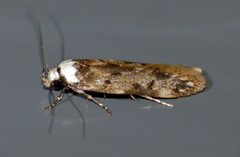
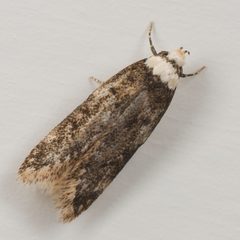
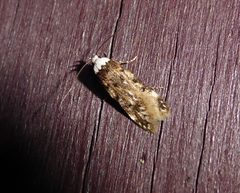
Endrosis is distinguished from related in Oecophorinae by the combination of white shoulders on the forewings and a generally pale coloration. The genus is most reliably identified through examination of the single included , E. sarcitrella, which has a wingspan of approximately 15–20 mm and characteristic white scaling at the base of the forewing. It resembles the brown house moth (Hofmannophila pseudospretella), but differs in its paler overall coloration and distinct white shoulder patches.
Images
Habitat
Associated with human dwellings and stored products; found in houses, barns, warehouses, and other buildings where dried organic materials accumulate. The thrives in warm, dry conditions with access to food sources such as stored grain, dried fruit, seeds, and animal detritus.
Distribution
distribution due to human transport; established in Europe, North America, and other regions worldwide. Distribution records from GBIF confirm presence in Denmark (DK) and Norway (NO).
Seasonality
may be encountered year-round in heated indoor environments. In temperate regions with unheated structures, activity is concentrated in warmer months.
Diet
Larvae feed on dried plant and animal matter including stored grain, cereals, dried fruit, seeds, wool, fur, feathers, and other keratinous materials. The is considered a pest of stored products.
Life Cycle
Complete with , larva, pupa, and stages. Larvae are scavengers that develop within stored materials. occurs in a silken cocoon. Development is continuous in favorable conditions, with multiple per year possible.
Behavior
. are attracted to light. Larvae construct silken tunnels or webs within food substrates.
Ecological Role
Decomposer of dried organic matter in anthropogenic environments. Serves as prey for various including spiders, , and birds in building interiors.
Human Relevance
Significant pest of stored food products and natural history collections. Larval feeding damages grain, dried fruit, seeds, wool, fur, feathers, and museum specimens. require in food storage facilities and museums.
Similar Taxa
- HofmannophilaBoth contain house in Oecophorinae with similar habits and ; Hofmannophila pseudospretella (brown house moth) differs in darker brown coloration without white shoulder patches.
More Details
Monotypy
Endrosis is currently treated as , containing only E. sarcitrella. Historical descriptions of additional in this have been rejected or reassigned to other genera.