
Hofmannophila pseudospretella
(Stainton, 1849)
Brown House Moth, Samenmotte (German)
A pest of stored products and dwellings. Larvae feed on keratinous materials including wool, fur, and feathers, as well as dried plant matter. are and exhibit complex sexual involving -mediated mate location. The is the sole member of its , though its distinctness from related genera remains under study.
Pronunciation
How to pronounce Hofmannophila pseudospretella: /hɒfˌmænəˈfɪlə ˌsjuːdoʊsprəˈtɛlə/
These audio files are automatically generated. While they are not always 100% accurate, they are a good starting point.
Identification
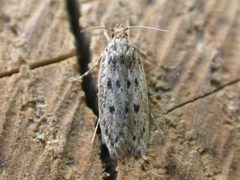
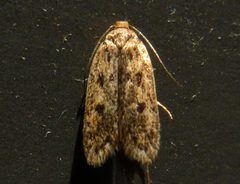
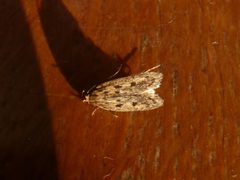
Distinguished from the common clothes moth (Tineola bisselliella) by larger size and more mottled brown forewing pattern. have a wingspan of approximately 15–20 mm. Forewings are brown with darker speckling; hindwings are pale grey-brown. Larvae are whitish with a brown capsule.
Images
Habitat
Human-associated environments including houses, warehouses, and storage facilities. Favors dark, undisturbed locations such as unheated basements, attics, and stored product storage areas.
Distribution
distribution associated with human commerce. Native to Europe; now established across North America, Australia, New Zealand, and other regions. Records include Austria, Belgium, Britain, France, and numerous other countries.
Seasonality
have been observed emerging in early June following larval development through winter months. Activity likely year-round in heated indoor environments.
Diet
Keratinous materials including wool, fur, feathers, and hair; also dried plant material such as dried mint (Mentha). Larvae possess specialized digestive (γ-glutamyl transpeptidase/isopeptidase) for breaking down isopeptide bonds in keratin proteins.
Life Cycle
Complete with larval development occurring through winter months. emerge in early summer (June) based on rearing observations. Copulation may last up to 24 hours. Females lay on substrates after mating.
Behavior
Young exhibit negative . Males locate females via olfactory cues; detection distance increases from minimal range to approximately 38 cm after females extend their ovipositor ("lock position") 2–3 days post-. Males possess specialized sensillae in -free grooves on antennal undersides for detection. Females show fewer and shorter antennal sensillae. Males can mate with at least three females. Post-copulation, females become positively geotactic and move to substrates for oviposition. Larvae exhibit gregarious with massive proliferation potential.
Ecological Role
Decomposer of keratinous and dried organic materials in human-modified environments. Pest of stored products and natural history collections.
Human Relevance
Significant pest of stored products, textiles, and museum specimens. Larvae cause severe damage to woolens, furs, dried herbs, and other stored materials. One documented reduced 50 kg bales of dried mint to dust within months. Control requires proper storage, monitoring, and in domestic and commercial settings.
Similar Taxa
- Tineola bisselliellaCommon clothes moth; similar keratin-feeding habit but smaller with more uniform golden-brown coloration. Hofmannophila pseudospretella is larger with more mottled patterning.
- Borkhausenia spp.Closely related ; taxonomic distinction from Hofmannophila remains under study. Morphological separation may require genitalic examination.
Sources and further reading
- BugGuide
- GBIF taxonomy match
- iNaturalist taxon
- NCBI Taxonomy
- Catalogue of Life
- Hofmannophila pseudospretella Stt. [Lep. Gelechiidae] hôte indésirable des habitations et des magasins
- Beobachtungen über das Sexualverhalten von Hofmannophila pseudospretella Stt.1
- The digestive system of the keratin‐feeding larvae of Hofmannophila pseudospretella (Lepidoptera: Oecophoridae)
- Identification of isopeptidase activity in the midgut of insects: Purification, properties and nutritional ecology of a Hofmannophila pseudospretella (Lepidoptera: Oecophoridae) larval enzyme
- The genome sequence of the Brown House-moth, Hofmannophila pseudospretella (Stainton, 1849).