
Hofmannophila
Spuler, 1910
brown house moth (for sole species H. pseudospretella)
Species Guides
1- Hofmannophila pseudospretella(Brown House Moth)
Hofmannophila is a of concealer moths ( Oecophoridae) containing a single , H. pseudospretella, commonly known as the brown house . The genus appears closely related to Borkhausenia. The sole species is a significant pest with nearly worldwide distribution, particularly abundant in Britain.
Pronunciation
How to pronounce Hofmannophila: /hɔfˌmænəˈfaɪlə/
These audio files are automatically generated. While they are not always 100% accurate, they are a good starting point.
Identification
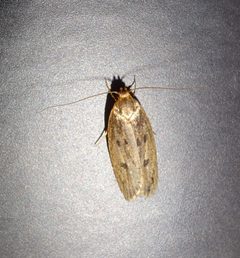
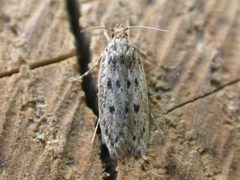
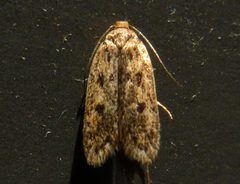
The is recognized by its status and the distinctive appearance of its sole member: pale ochre forewings with blackish-brown patches, a prominent discal spot, smaller cellular spots, and brownish-grey hindwings. are simple and threadlike. Wing span 15–26 mm. For definitive identification, reference to the single H. pseudospretella is required.
Images
Habitat
Strongly ; primarily inhabits private houses and commercial buildings. Smaller occur outside human settings, with larvae documented in birds' nests feeding on droppings and detritus.
Distribution
Originally Asian; introduced to Europe in the 1840s. Now found almost worldwide, especially common in Britain. Distribution records include Denmark (DK) and Norway (NO).
Seasonality
active May–September, though present year-round in heated buildings. Larvae active June–April. Can fly and reproduce continuously in suitable indoor conditions.
Life Cycle
elliptical with longitudinal grooves and transverse lines, white to yellow, hatch in 10–20 days. Larvae have brown , translucent dull white body, and pale yellowish-brown legs; body color varies with gut contents. Pupae yellowish-brown with strongly hooked setae on terminal abdominal segments. Females lay up to 260 per cycle (400–500 reported for large females). Larvae spin silken tubes, require high humidity, and travel 2–3 days before . Pupal duration shortened by higher temperature; severe frost kills larvae.
Behavior
strongly attracted to light and capable of year-round. Young adults exhibit negative geotaxis. Females not fertilized within 2–3 days extend ovipositor as signaling posture, enabling detection by males at up to 38 cm. Copulation may last up to 24 hours. Males can fertilize at least three females. After copulation, females become positively geotactic and deposit on substrates. Larvae exhibit gregarious with massive proliferation potential.
Ecological Role
Significant : the mite Cheyletus eruditus. In natural settings, larvae contribute to detritus breakdown in birds' nests.
Human Relevance
Serious domestic and commercial pest. Larvae destroy stored cereals, dried fruit, seeds, clothing and furniture fabrics, fur, wood floor inlays, book bindings, wine corks, and leather. Unusual keratin-degrading ability mediated by lactic acid bacteria in . Larvae bite through synthetic carpet fibers to construct , rendering conventional -proofing agents largely ineffective. Considered more damaging in Britain than elsewhere globally.
Similar Taxa
- BorkhauseniaClosely related ; Hofmannophila's taxonomic distinctness remains to be conclusively proven and it may be closely allied to or congeneric with Borkhausenia
- Tineola bisselliellaAnother keratinophagous pest with which H. pseudospretella shares similarities and , though Tineola belongs to Tineidae
More Details
Digestive specializations
Larvae possess an additional muscle layer in the outer wall of the compared to other keratinophagous , and show less differentiation between midgut regions. Midgut epithelial enlarge after feeding, with large free cytoplasmic spheres associated with fed larvae. A γ-glutamyl transpeptidase (isopeptidase) of 80 kDa has been purified from larval midgut; this is rare among insects but present in other keratinophagous lepidopteran larvae and predatory carabid beetles.
Sexual communication
Males possess sexual -sensitive sensillae in a -free groove on the surface of the ; females have fewer and shorter sensillae. Initial mate location occurs only at very short range via olfaction, extending to 38 cm after females assume the ovipositor-extended posture.
Sources and further reading
- BugGuide
- Wikipedia
- GBIF taxonomy match
- iNaturalist taxon
- NCBI Taxonomy
- Catalogue of Life
- Hofmannophila pseudospretella Stt. [Lep. Gelechiidae] hôte indésirable des habitations et des magasins
- Beobachtungen über das Sexualverhalten von Hofmannophila pseudospretella Stt.1
- The digestive system of the keratin‐feeding larvae of Hofmannophila pseudospretella (Lepidoptera: Oecophoridae)
- Identification of isopeptidase activity in the midgut of insects: Purification, properties and nutritional ecology of a Hofmannophila pseudospretella (Lepidoptera: Oecophoridae) larval enzyme
- The genome sequence of the Brown House-moth, Hofmannophila pseudospretella (Stainton, 1849).