
Endrosis sarcitrella
Linnaeus, 1758
White-shouldered House Moth
Endrosis sarcitrella, the White-shouldered House Moth, is a gelechioid in the Oecophoridae. It is the sole in its , which is currently considered despite historical descriptions of presumed . The species is widely distributed across Europe and has been introduced to other regions through human activity. It is commonly associated with human dwellings and stored products.
Pronunciation
How to pronounce Endrosis sarcitrella: /ɛnˈdroʊsɪs sɑrˈsɪtrɛlə/
These audio files are automatically generated. While they are not always 100% accurate, they are a good starting point.
Identification
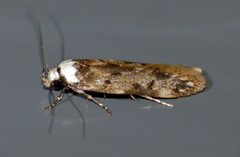
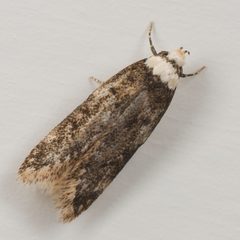
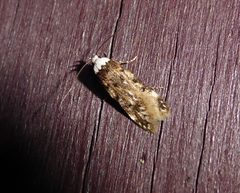
The pale shoulder patch contrasting with the darker, speckled remainder of the forewing distinguishes this from the similar brown house moth (Hofmannophila pseudospretella), which has more uniformly brown forewings. The dark central spot on the forewing is also a useful diagnostic feature. can be separated from other small domestic by the combination of white shoulder patches and the overall pale ground color with dark speckling.
Images
Appearance
have white or pale cream forewings with a distinctive dark brown or blackish spot near the center and scattered darker speckling. The shoulders (basal area of the forewing) are noticeably paler, giving the its . Hindwings are pale grayish. Wingspan ranges approximately 15-20 mm. Larvae are whitish with a brownish .
Habitat
Strongly associated with human-built structures, particularly houses, barns, warehouses, and other buildings where stored products are kept. Also found in bird nests, especially those of domestic pigeons and poultry, where larvae feed on organic debris. Rarely occurs in natural outdoor .
Distribution
Native to the Palearctic region with records across Europe including Austria, Belgium, and the United Kingdom. Introduced and established in North America, Australia, New Zealand, and other regions through human commerce. in distribution due to habits.
Seasonality
are active year-round in heated buildings. In unheated structures or outdoor situations, peak activity occurs from late spring through autumn. Multiple overlapping occur annually in favorable conditions.
Diet
Larvae feed on a wide range of dry organic matter including stored grain, cereal products, dried fruit, nuts, seeds, wool, fur, feathers, dead insects, and other detritus. Has been reported from bird nests feeding on , feathers, and carcasses.
Life Cycle
Complete with , larva, pupa, and stages. Females lay eggs on suitable food material. Larval development varies with temperature and food quality, potentially lasting several weeks to months. occurs in a silken cocoon, often within the food substrate. time can be as short as 8-10 weeks under optimal conditions.
Behavior
. are attracted to light. Larvae are scavengers that web together food particles and debris while feeding. Capable of surviving extended periods without food. Adults do not feed.
Ecological Role
Decomposer and scavenger in human-associated environments. Contributes to breakdown of organic debris in bird nests and stored product facilities. Serves as prey for various including spiders, , and insectivorous birds in building environments.
Human Relevance
Significant pest of stored food products and natural history collections. Can infest grain, flour, dried fruit, nuts, and other stored goods. Damages wool, fur, and feather items. Economic impact generally less severe than some other stored product , but persistent occur in domestic and commercial settings. Control relies on , temperature management, and .
Similar Taxa
- Hofmannophila pseudospretellaBrown house moth with uniformly brown forewings lacking the pale shoulder patch; often found in similar
- Tinea pellionellaCase-bearing clothes moth with more uniformly buff or brown coloration and distinctive larval cases
More Details
Taxonomic history
The Endrosis was long thought to contain multiple , but E. sarcitrella is now recognized as the only valid species. The basionym Phalaena sarcitrella reflects its original description by Linnaeus in 1758.