
Symmetrischema tangolias
(Gyen, 1913)
South American potato tuber moth, Andean potato tuber moth, tomato stemborer
Symmetrischema tangolias is a gelechiid native to the Andean region of South America that has become a globally significant agricultural pest. The infests solanaceous crops, particularly potatoes and tomatoes, with larvae burrowing into stems, leaves, petioles, and tubers. It has established in North America, Australia, New Zealand, Indonesia, and Chile. The species is adapted to cooler temperatures than the related potato tuber moth Phthorimaea operculella, with optimal development occurring between 14–17°C.
Pronunciation
How to pronounce Symmetrischema tangolias: /sɪˌmɛtrɪˈʃiːmə tæŋˈɡoʊliəs/
These audio files are automatically generated. While they are not always 100% accurate, they are a good starting point.
Identification
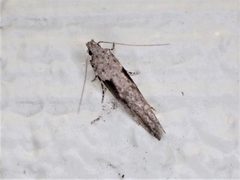
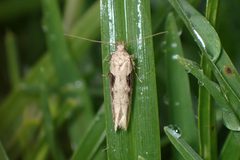
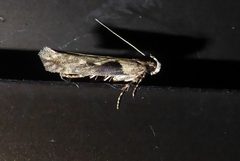
distinguished from similar gelechiid moths by the combination of black triangular patches on forewing lateral margins and the silver-gray ground color. The related Phthorimaea operculella lacks these distinct black triangular markings and has a more uniformly patterned forewing. Larval identification requires examination of capsule coloration and body setation; molecular or rearing-based confirmation is often necessary. in abdominal shape provides a secondary diagnostic feature for adults.
Images
Habitat
Larval stages occur within plant tissues: potato and tomato leaves, petioles, stems, and tubers. In storage environments, infests seed potatoes in rustic warehouse facilities without active temperature control or refrigeration. Thrives in sub-temperate climates with temperatures between 10–28°C; optimal survival at 14–17°C. Andean highland documented at elevations of 2750–3350 m.
Distribution
Native to the Andean mountain region of South America, particularly Peru and Bolivia. Natural range extends to Ecuador and Colombia. established in United States (California, Louisiana, Mississippi, Washington), Mexico, Australia (New South Wales, Tasmania, Victoria), New Zealand, Indonesia, and Chile. First detected in New Zealand in 1979 (Waitara, Taranaki).
Seasonality
Multiple overlapping throughout the year in suitable climates; 12 lifecycles annually reported under favorable conditions. Each generation lasts 4–7 weeks. activity occurs during nighttime. development extends approximately 190 days under cooler conditions. Activity constrained by temperature thresholds: development ceases below ~8°C and declines above 28°C.
Diet
Larvae feed on solanaceous plants, primarily potato (Solanum tuberosum) and tomato (Solanum lycopersicum). In North America, has been observed feeding on black nightshade (Solanum nigrum complex). larvae enter tissues through axils, wounds, or stem buds. In storage, larvae burrow into tubers creating internal galleries. do not feed.
Host Associations
- Solanum tuberosum - primary Potato tubers, stems, leaves, and petioles
- Solanum lycopersicum - primary Tomato stems, leaves, and petioles
- Solanum aviculare - Native New Zealand ; larvae burrow into stems causing dark
- Solanum nigrum - Black nightshade; reported in North America
Life Cycle
Females lay 140–185 per , depositing them in leaf axils and stem slits during nighttime. Eggs hatch in approximately 4–7 days under optimal conditions. Larvae bore into tissues, creating entry holes with visible excrement. Larval development temperature-dependent, with optimal range 10–28°C. occurs within a cocoon in plant debris or soil; pupal exit hole approximately 2–3 mm in diameter. follows after approximately one day within cocoon. Adult females live 3–4 nights. time varies from 4–7 weeks depending on temperature; up to 12 overlapping generations annually possible.
Behavior
oviposition ; females deposit on plants during nighttime hours. Larvae exhibit stem-boring behavior, entering through axils, wounds, or stem buds. Entry holes marked by excrement accumulation. Severe stem damage causes host wilting or stem breakage. occurs in protected locations within plant debris. (3E,7Z)-tetradecadienyl acetate used for mate location.
Ecological Role
Major agricultural pest causing direct damage to solanaceous crops and stored produce. Larval tunneling facilitates secondary by microorganisms (fungi and bacteria), accelerating deterioration. In Andean smallholder systems, can reach 100% of stored tubers in unprotected facilities. Co-occurrence with Phthorimaea operculella may exacerbate crop damage. Potential prey for diverse including Heteroptera, Hymenoptera, Dermaptera, Coleoptera, Neuroptera, Thysanoptera, Phytoseiidae mites, and Lycosidae spiders, though specific predator-prey relationships require further study.
Human Relevance
Significant economic pest of potato and tomato production globally. Field losses in Andean regions can reach 30%; storage losses in unprotected facilities can total 100% of house-stored produce within 3–4 months. Infested tubers lose commercial value due to internal damage and secondary . Management approaches include trapping for monitoring and male attraction, repellents (Ambrosia peruviana, Artemisia absinthium, Minthostachys mollis, Eucalyptus globulus) for storage protection, and using such as Apanteles subandinus. Climate change may shift distribution potential, with reduced establishment in tropical/subtropical regions but increased risk in temperate zones including Western Europe.
Similar Taxa
- Phthorimaea operculellaCommon potato tuber moth; similar range and damage . Distinguished by lack of black triangular forewing patches and preference for warmer temperatures. S. tangolias more cold-adapted with optimal development at 14–17°C versus higher optima for P. operculella.
- Tuta absolutaTomato leafminer in same ; causes similar stem and leaf mining damage. Distinguished by different wing pattern and larval . Geographic distributions overlap in some regions.
More Details
Temperature physiology
More cold-adapted than ; develops at 8–28.8°C with maximum growth rate (λ = 1.053) at 21°C. and pupae show >80% survival under optimal temperature conditions. Lower temperature threshold approximately 8°C; and oviposition decline below this threshold.
Pheromone use
(3E,7Z)-tetradecadienyl acetate enables monitoring through -baited water or funnel traps, supporting early detection and programs.
Climate change projections
Rising temperatures may decrease establishment potential in tropical and subtropical regions while increasing suitability in temperate zones. Potential spread to Western Europe (Spain, France, Italy, Ireland) predicted.
Sources and further reading
- BugGuide
- Wikipedia
- GBIF taxonomy match
- iNaturalist taxon
- NCBI Taxonomy
- Catalogue of Life
- Symmetrischema tangolias . [Distribution map].
- Effectiveness of Repellent Plants for Controlling Potato Tuber Moth (Symmetrischema tangolias) in the Andean Highlands
- Temperature‐dependent phenology and growth potential of the Andean potato tuber moth, Symmetrischema tangolias (Gyen) (Lep., Gelechiidae)
- A temperature‐dependent phenology model for Apanteles subandinus Blanchard, parasitoid of Phthorimaea operculella Zeller and Symmetrischema tangolias (Gyen)