
Aristotelia
Hübner, [1825]
twirler moths
Species Guides
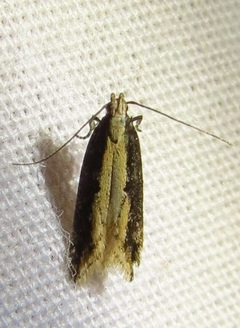
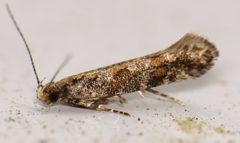
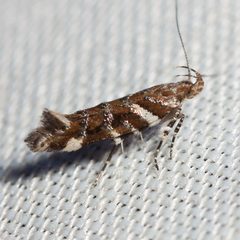
28Aristotelia is a of micro- in the Gelechiidae, commonly known as twirler moths. These small, boldly marked moths are primarily and attracted to artificial light sources. The genus contains approximately 35 named in North America, with additional undescribed species awaiting scientific description. Larvae are specialized feeders on particular plants, with diverse plant families including Salicaceae, Solanaceae, Rosaceae, Fagaceae, Fabaceae, and Asteraceae documented as hosts across different species.
Pronunciation
How to pronounce Aristotelia: //ˌæ.rɪ.stəˈtɛl.i.ə//
These audio files are automatically generated. While they are not always 100% accurate, they are a good starting point.
Identification
Aristotelia are distinguished from other gelechiid moths by their distinctive bold markings and small size. Positive identification to species level typically requires examination of genitalia characters. The can be separated from similar twirler moth genera by wing pattern elements and structural features, though these require expert evaluation. Specimens attracted to blacklights in dry mixed conifer forest and wooded with good floral diversity are consistent with documented occurrences.
Images
Appearance
Tiny with bold, contrasting color patterns. Wing patterns are distinctive and -specific, though specific pattern elements vary among species. are small enough to be categorized as 'micros'—often difficult to identify without close examination or dissection of genitalia.
Habitat
Wooded areas with cliffs and landscape vegetation; dry mixed conifer forest with oaks at elevations around 7,000 feet. with good floral diversity support . are attracted to ultraviolet and artificial light sources at night.
Distribution
Documented from Colorado (Lyons, Colorado Springs area), New Mexico (Pinos Altos, Grant County), and other western North American locations. The occurs across North America with distributions varying; 35 named species are known north of Mexico with the center of diversity in the southwestern United States.
Seasonality
have been documented in July and August during blacklight surveys. Activity appears to peak during mid-summer months, coinciding with National Week observations in late July.
Host Associations
- Salicaceae - larval plantdocumented for some
- Solanaceae - larval plantdocumented for some
- Rosaceae - larval plantdocumented for some
- Fagaceae - larval plantdocumented for some
- Fabaceae - larval plantdocumented for some
- Asteraceae - larval plantdocumented for some
Life Cycle
Complete with , larval, pupal, and stages. Larvae are specialized feeders on particular plant . Specific details of sites and stage are not documented in available sources.
Behavior
; are strongly attracted to blacklights and ultraviolet light sources. activity occurs after sunset. One , Aristotelia elegantella, has been documented as a yard visitor in Colorado Springs, suggesting some species may occur in suburban or semi-urban settings with appropriate vegetation.
Ecological Role
Larvae function as specialized herbivores on their plants. likely serve as prey for including spiders and other arthropods attracted to light sources. Specific roles or broader functions are not documented.
Human Relevance
Documented by citizen scientists during National Week events and blacklight surveys. Some may be of interest to lepidopterists due to their distinctive appearance and identification challenges. No documented economic or agricultural significance.
Similar Taxa
- Other Gelechiidae generaSimilar small size and general 'twirler moth' ; distinguished by wing pattern elements and genitalia structure
- EthmiaAnother of boldly marked micro- in Depressariidae (sometimes confused in general micro-moth surveys); Ethmia are typically black, white, and gray with more uniform appearance
- ArgyresthiaSmall micro- with metallic markings; Argyresthia are smaller (3.2-6.8 mm), often white with transverse metallic stripes, and are conifer needle or broadleaf miners
More Details
Taxonomic note
Aristotelia is a homonym shared with a plant in Elaeocarpaceae (Aristotelia L'Her., 1785). The genus was established by Hübner in 1825. These are entirely unrelated organisms and should not be confused.
Undescribed diversity
Many Aristotelia in North America remain undescribed by scientists. The 35 named species north of Mexico represent only a portion of actual diversity, making field identification to species challenging or impossible for many specimens.