
Aristotelia bifasciella
Busck, 1903
Aristotelia bifasciella is a small in the twirler moth Gelechiidae, described by August Busck in 1903. It occurs in the southwestern United States, specifically California, Arizona, and Utah. The is distinguished by its distinctive wing pattern featuring two dark brown transverse bands on a pale yellowish-white background. Like other members of the Aristotelia, it is attracted to ultraviolet light sources at night.
Pronunciation
How to pronounce Aristotelia bifasciella: /ˌæɹɪstəˈtɛliə ˌbaɪfæsiˈɛlə/
These audio files are automatically generated. While they are not always 100% accurate, they are a good starting point.
Identification
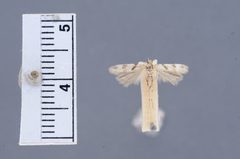
The forewings are dirty yellowish white with two conspicuous dark brown fasciae that provide the basis for the name 'bifasciella' (two-banded). The first fascia runs obliquely from the basal third of the to the middle of the edge; the second is broader, nearly perpendicular to the costal edge at the third, and shaded with lighter yellowish brown toward the dorsal edge. A dark brown costal spot appears just before the apex, continuing across the wing in a very light yellowish area. The extreme base of the costa is blackish brown. Hindwings are light fuscous. Wingspan measures 14–16 mm.
Images
Distribution
Recorded from California, Arizona, and Utah in the southwestern United States.
Behavior
are and attracted to blacklights and other ultraviolet light sources.
Similar Taxa
- Aristotelia elegantellaAnother small Aristotelia with bold markings; A. bifasciella is distinguished by its two prominent dark brown fasciae rather than other pattern elements
- Aristotelia sp.Other undescribed or similar in the ; precise identification requires examination of the characteristic two-banded forewing pattern and specific measurements