
Aristotelia elegantella
(Chambers, 1874)
Elegant Aristotelia
Aristotelia elegantella is a tiny in the Gelechiidae, commonly known as the Elegant Aristotelia. It was described by Vactor Tousey Chambers in 1874 and is found across much of North America, from southern Canada through the western and central United States. The is notable for its striking wing pattern featuring bands of white, ochreous-yellow, and iridescent brown. It has been recorded at blacklight setups and appears to be attracted to artificial light sources.
Pronunciation
How to pronounce Aristotelia elegantella: //ˌæɹɪstəˈtiːliə ˌɛləɡænˈtɛlə//
These audio files are automatically generated. While they are not always 100% accurate, they are a good starting point.
Identification
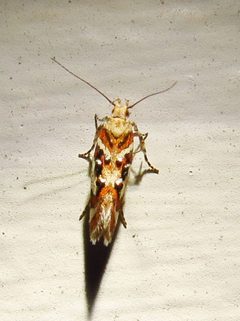
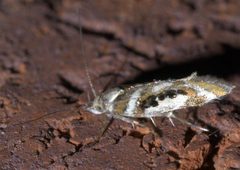
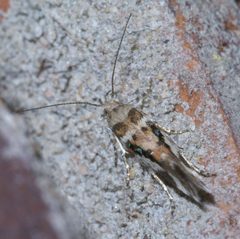
The combination of small size (~13 mm wingspan), distinctive banded forewing pattern with white, ochreous-yellow, and iridescent brown elements, and the presence of raised metallic tufts on the margin separate this from other Aristotelia. The oblong -yellow or golden patch near the wing apex, enclosed by curved brown lines, is particularly distinctive. Similar Aristotelia species lack this specific arrangement of metallic elevations and the golden patch.
Images
Appearance
A small with wingspan approximately 13 mm. Forewing base is white and iridescent, wider on the margin than costal margin. An oblique ochreous or yellowish-orange band crosses the wing, margined with brown anteriorly and posteriorly. This is followed by an oblique white band, widely margined behind by an iridescent brown line that terminates at a smooth tuft of raised metallic on the dorsal margin. A dark brown margin extends from the second brown fascia backwards along the disc, containing three smooth metallic elevations similar to the dorsal tuft; the wing between this streak and the is white, while between the streak and dorsal margin it is white and pale ochreous. The streak terminates just before the dorsal cilia at a curved fascia that is convex toward the base, reddish ochreous on the dorsal margin and brown on the costal margin. This is followed by another oblique fascia nearest the tip on the costal margin, with a wide white costal portion and brown dorsal portion that is brilliant metallic in some lights; the brown portion narrows where it meets the white and curves around behind it to the costal margin, then curves as a narrow line backwards around the apex at the base of the cilia, returning to its origin on the dorsal margin, thus enclosing an oblong -yellow or golden patch parallel with the base of the dorsal cilia. In some lights this fascia appears dull brown without metallic sheen, and the yellowish ochreous parts become almost brick red.
Distribution
North America: recorded from Arizona, California, Colorado, Illinois, Indiana, Iowa, Kansas, Kentucky, Louisiana, Mississippi, New Mexico, Ohio, Oklahoma, Ontario (Canada), Texas, and Utah.
Behavior
Attracted to blacklight/ultraviolet light sources; has been documented at backyard blacklight setups in Colorado.
Similar Taxa
- Aristotelia sp.Other in the Aristotelia share similar small size and bold markings, but A. elegantella is distinguished by its specific pattern of ochreous bands, iridescent brown margins, and the distinctive golden patch. The genus as a whole comprises tiny 'twirler moths' with striking patterns, but species identification requires attention to the specific arrangement of colored bands and metallic tufts.