
Depressaria radiella
(Goeze, 1783)
parsnip moth, parsnip webworm
Depressaria radiella is a Eurasian introduced to North America in 1862 (Ontario) and New Zealand in 2004. It is a 'superspecialist' herbivore effectively restricted to two closely related apiaceous (Heracleum and Pastinaca) throughout its native and introduced ranges. The is , with active from August through May after . It has undergone slow westward expansion across North America over 160+ years, reaching the West Coast only after more than 50 years. The species exhibits lower genetic diversity than its D. depressana, possibly reflecting its narrow specialization.
Pronunciation
How to pronounce Depressaria radiella: //dɛˌprɛˈsɛˌriə rəˈdiːɛlə//
These audio files are automatically generated. While they are not always 100% accurate, they are a good starting point.
Identification
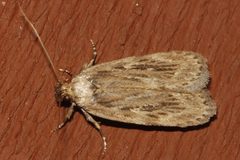
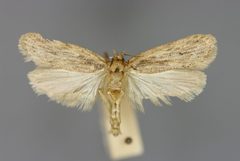
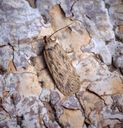
Separated from similar Depressaria by the distinctive pattern of numerous longitudinal black streaks on the forewings that emanate from the central disc area, terminate at the 3/4 fascia, and consistently end before reaching the wing margin while closely following venation lines.
Images
Appearance
Wingspan 19–27 mm. Forewings with numerous longitudinal black streaks emanating from central area of disc; most streaks terminate at fascia at 3/4 but always finish before the termen, closely following the venation.
Habitat
Associated with hostplants in the Apiaceae, particularly in open where Heracleum and Pastinaca occur. Found across much of Canada and the United States following range expansion from initial introduction point in Ontario.
Distribution
Native to most of Europe (except Portugal and most of the Balkan Peninsula). Introduced to North America: first documented in Ontario in 1862, subsequently expanded westward over 160+ years to reach the West Coast. Present across much of Canada and the United States. Also introduced to New Zealand, first recorded in January 2004.
Seasonality
on wing from August to May of the following year after in sheltered places. : one per year.
Diet
herbivore feeding on reproductive structures (flowers and developing seeds) of Apiaceae. Effectively restricted to two : Heracleum and Pastinaca. Specifically documented on Heracleum sphondylium, Pastinaca sativa, Apium nodiflorum (Europe); Pastinaca sativa and Heracleum maximum in North America.
Host Associations
- Pastinaca sativa - primary wild and domesticated parsnip; in North America
- Heracleum maximum - American cow-parsnip; only native North American acquired since introduction
- Heracleum sphondylium - European
- Apium nodiflorum - European
Life Cycle
throughout its range. Larvae feed on flowers and developing seeds enclosed in silk webbing. occurs in the main stem of the food plant. emerge in August, overwinter in sheltered places, and remain active until May.
Behavior
Larvae defend feeding territories by enclosing an umbel in silk webbing. Safely metabolizes ingested furocoumarins () from plants. feeding on different host plants show differential metabolism of angular furanocoumarins. In New Zealand, caused up to 75% reduction in seed production in previously uninfested Pastinaca sativa populations.
Ecological Role
Herbivore exerting documented selection pressure on plants. Drives increases in toxic furanocoumarin (sphondin) content in North American wild parsnip , indicating coevolutionary interaction. Potential threat to native North American umbellifers, though host range remains narrow.
Human Relevance
Agricultural pest of parsnip crops. potential: in New Zealand, heavy significantly reduce seed production of Pastinaca sativa. Subject of coevolutionary research documenting plant defense evolution.
Similar Taxa
- Depressaria depressanacongeneric ; distinguished by broader range across multiple Apiaceae tribes, higher genetic diversity, faster rate, and more recent North American introduction (2008 vs. 1862)
- Agonopterix heraclianahistorically confused with D. radiella; Linnaeus' original description of 'Phalaena heracliana' actually referred to this , not the parsnip
Misconceptions
The has been subject to 200 years of taxonomic confusion. Linnaeus' 1758 description of 'Phalaena (Tortrix) heracliana' was misidentified as this species by early entomologists; the name actually referred to Agonopterix heracliana. The species was long known as D. pastinacella (based on Duponchel 1838) until ICZN recognition of Goeze's 1783 description as the valid earliest name.
Sources and further reading
- BugGuide
- Wikipedia
- GBIF taxonomy match
- iNaturalist taxon
- NCBI Taxonomy
- Catalogue of Life
- Genetic Structure and Colonization of North America by Depressaria depressana (Fabricius 1775) (Lepidoptera: Depressariidae) over 15 Years; Contrasts with Westward Expansion of Depressaria radiella (Goeze, 1783) over 160 Years
- Degree of dietary specialization on furanocoumarin-containing hostplants in a newly invasive species, Depressaria depressana (Lepidoptera: Depressariidae)