
Depressaria depressana
(Fabricius, 1775)
Purple Carrot-seed Moth, Blunt's Flat-body
Depressaria depressana is a small in the Depressariidae, native to Eurasia and introduced to North America around 2008–2009. It is a family-level herbivore of Apiaceae, feeding on reproductive structures of wild carrot, parsnip, and related umbellifers. The has undergone rapid range expansion in eastern North America, exhibiting higher genetic diversity and capacity than its D. radiella. are active from spring through early fall with multiple per year in warmer regions.
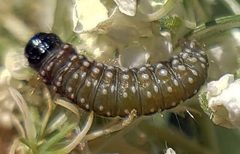
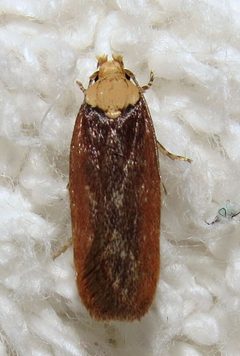
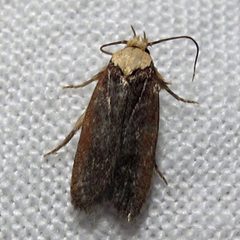
Pronunciation
How to pronounce Depressaria depressana: /dɛˌprɛsˈɑːriə dɛˌprɛsˈænə/
These audio files are automatically generated. While they are not always 100% accurate, they are a good starting point.
Identification
Distinguished from the related Depressaria radiella (parsnip webworm) by broader plant range across multiple tribes of Apiaceae rather than restriction to Pastinaca and Heracleum. D. depressana exhibits lower furanocoumarin detoxification metabolism than D. radiella. Genetic analysis may be required for definitive identification where ranges overlap.
Images
Appearance
Small with wingspan of 14–20 mm. have narrow, somewhat flattened wings held close to the body at rest, consistent with the 'flat-body'. Coloration and pattern details are not specified in available sources.
Habitat
Associated with plants in the Apiaceae. Larvae are found on umbels of wild carrot (Daucus carota) and related . Specific requirements beyond host plant presence are not documented.
Distribution
Native to most of Europe, the Near East, North Africa, and the eastern Palearctic. In North America, first documented in 2008–2009 and now established from New York, Connecticut, Massachusetts, Illinois, Wisconsin, and Pennsylvania, with ongoing range expansion in eastern United States.
Seasonality
active from March to May in northern Europe with one . Multivoltine with activity from late spring to early fall in central Illinois. Two generations in the northern Caucasus; up to three generations in southern Ukraine.
Diet
herbivore of Apiaceae. Larvae feed on reproductive structures (umbels, seeds) of Daucus carota, Pimpinella, Pastinaca sativa, Seseli, Peucedanum oreoselinum, and Zizia aurea. Highest feeding observed on Daucus carota.
Host Associations
- Daucus carota - larval wild carrot; highest feeding
- Pastinaca sativa - larval parsnip/wild parsnip
- Pimpinella - larval level
- Seseli - larval level
- Peucedanum oreoselinum - larval level
- Zizia aurea - larval native North American ; fruits consumed
- Heracleum maximum - larval American cow-parsnip
Life Cycle
Multivoltine with number of varying by latitude: one generation in northern Europe, two in the northern Caucasus, and up to three in southern Ukraine. Detailed developmental stages are not documented in available sources.
Behavior
Larvae feed on developing seeds in umbels of plants. exhibit rapid capacity with low genetic structuring across geographic distances, indicating high ability. Lower furanocoumarin detoxification metabolism compared to the D. radiella.
Ecological Role
Herbivore of native and introduced Apiaceae in North America. As a newly , it may exert selection pressure on plant and potentially threaten native North American umbellifers. Its broad host range contrasts with the narrow specialization of D. radiella, offering a comparative model for herbivore management.
Human Relevance
Potential agricultural pest of carrot and parsnip crops. Its recent invasion of North America (since 2008–2009) has prompted research into its genetics and plant relationships to inform management strategies.
Similar Taxa
- Depressaria radiella with similar ; distinguished by narrower range restricted primarily to Pastinaca and Heracleum, higher furanocoumarin metabolism, and slower historical range expansion in North America
- Other Depressariidae members share flattened body form; identification to level requires examination of associations, genetic analysis, or genitalia dissection
More Details
Invasion History
First reported in North America in 2008, with scientific documentation in 2015. Has expanded its range more rapidly than D. radiella, which took over 160 years for comparable westward expansion.
Genetic Diversity
COI haplotype analysis reveals higher genetic diversity in North American than in the D. radiella, suggesting multiple introductions, genetically diverse founding population, or high ongoing .
Sources and further reading
- BugGuide
- Wikipedia
- GBIF taxonomy match
- iNaturalist taxon
- NCBI Taxonomy
- Catalogue of Life
- Degree of dietary specialization on furanocoumarin-containing hostplants in a newly invasive species, Depressaria depressana (Lepidoptera: Depressariidae)
- Genetic Structure and Colonization of North America by Depressaria depressana (Fabricius 1775) (Lepidoptera: Depressariidae) over 15 Years; Contrasts with Westward Expansion of Depressaria radiella (Goeze, 1783) over 160 Years