
Homadaula anisocentra
Meyrick, 1922
mimosa webworm, Mimosa Webworm Moth
Homadaula anisocentra, commonly known as the mimosa webworm, is an introduced in the Galacticidae (formerly placed in Plutellidae). Native to China, it was accidentally introduced to the United States in the 1940s and has become a significant pest of ornamental trees. The species primarily attacks mimosa (Albizia julibrissin) and honeylocust (Gleditsia triacanthos), where larvae construct silk webbing to feed on leaves. It completes two annually in the Mid-Atlantic region, with an additional third generation in southern states.
Pronunciation
How to pronounce Homadaula anisocentra: //ˌhəməˈdaʊlə ˌænɪsoʊˈsɛntrə//
These audio files are automatically generated. While they are not always 100% accurate, they are a good starting point.
Identification
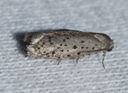
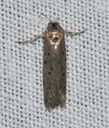
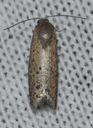
are recognized by their small size, silvery gray coloration, and wings densely speckled with black dots. Larvae are identified by their green to dark brown coloration with white stripes and their association with silk webbing on mimosa or honeylocust foliage. The can be distinguished from the fall webworm (Hyphantria cunea) by preference—mimosa webworm specifically targets Albizia julibrissin and Gleditsia triacanthos rather than the broad host range of fall webworm—and by the timing and appearance of webbing structures.
Images
Appearance
are approximately 10 mm in length with silvery gray wings densely covered in small black dots. Larvae reach approximately 15 mm in length and are variable in coloration from green to dark brown, marked with distinct longitudinal white stripes.
Habitat
Urban and suburban landscapes, parks, and streetscapes where trees (mimosa and honeylocust) are cultivated. Larvae feed within protective silk webbing on host foliage. Pupae overwinter in protected locations including leaf litter, soil, and urban microhabitats that provide thermal buffering.
Distribution
Native to China; introduced to the United States in the 1940s. Established throughout the eastern and central United States where trees occur.
Seasonality
Two per year in the Mid-Atlantic region (Maryland, Pennsylvania); three generations in southern states (Georgia, Florida, Alabama). emerge in late spring to early summer. Larval first occurrence correlates with approximately 543 growing .
Diet
Larvae feed on foliage of mimosa (Albizia julibrissin) and honeylocust (Gleditsia triacanthos).
Host Associations
- Albizia julibrissin - primary mimosa
- Gleditsia triacanthos - primary honeylocust
Life Cycle
Complete . laid on undersides of leaves. Larvae feed within expanding silk webs. occurs in protected locations on or near trees. Overwinters as pupae. Two to three annually depending on latitude.
Behavior
Larvae construct communal silk webbing that expands to encompass increasing numbers of leaves as they grow. This webbing provides protection from while larvae feed on enclosed foliage. are active fliers in late spring and summer.
Ecological Role
Human Relevance
Considered a significant pest of ornamental landscaping. Heavy cause defoliation and aesthetic damage to mimosa and honeylocust, particularly affecting thornless honeylocust cultivars. Some cultivars (Moraine, Shademaster, Imperial) show partial resistance. Management includes manual removal of webs, with Bacillus thuringiensis, and reduced-risk .
Similar Taxa
- Hyphantria cuneaFall webworm constructs similar silk nests but has broader range (100+ ), appears earlier in season (May-June versus summer), and lacks specific association with mimosa/honeylocust
- Malacosoma americanumEastern tent caterpillar builds tents in branch crotches near trunk in early spring (March-April), primarily on Rosaceae , not mimosa or honeylocust
Sources and further reading
- BugGuide
- Wikipedia
- GBIF taxonomy match
- iNaturalist taxon
- NCBI Taxonomy
- Catalogue of Life
- Webworms of the fall - Fall webworm, Hyphantria cunea and mimosa webworm, Homadaula anisocentra — Bug of the Week
- Oviposition behavior of the mimosa webworm Homadaula anisocentra Meyrick (Lepidoptera: Plutellidae)
- Overwintering survivorship of pupae of the mimosa web worm, Homadaula anisocentra (Lepidoptera: Plutellidae), in an urban landscape
- Seasonal Abundance ofHomadaula anisocentra(Lepidoptera: Plutellidae) and Two Parasitoids,Elasmus albizziae(Hymenoptera: Elasmidae) andParania geniculata(Hymenoptera: Ichneumonidae), in an Urban Forest