
Paranthrene asilipennis
(Boisduval, 1832)
Oak Stump Borer Moth
Paranthrene asilipennis, known as the Oak Stump Borer , is a clearwing moth in the Sesiidae. Like other sesiids, it exhibits mimicry through transparent wings and a wasp-like body form. The has been documented across Nearctic and Neotropical regions. It belongs to a whose larvae are associated with woody plants.
Pronunciation
How to pronounce Paranthrene asilipennis: /ˌpærənˈθriːni əˌsaɪlɪˈpɛnɪs/
These audio files are automatically generated. While they are not always 100% accurate, they are a good starting point.
Identification
Distinguished from other clearwing moths by specific wing venation patterns and body markings. Separated from the related Paranthrene robiniae (Locust Borer) by association and subtle morphological differences. The -mimicking appearance with transparent wings separates it from non-sesiid . Accurate identification may require examination of genitalia or molecular analysis.
Images
Appearance
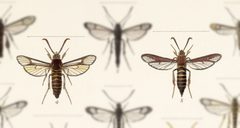
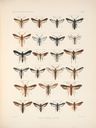
have partially transparent wings with reduced scaling, a characteristic feature of clearwing moths. The body is slender with -like coloration, typically involving dark and light patterning. Wings have dark borders and . The overall appearance mimics stinging wasps, a form of protective mimicry common in Sesiidae.
Habitat
Associated with oak woodlands and areas where oak trees occur. Larval includes living or decaying oak wood, particularly stumps and trunks.
Distribution
Recorded from Nearctic and Neotropical regions. Specific country-level distribution requires further verification from specimen records.
Diet
Larvae bore into oak (Quercus) wood. feeding habits are not well documented; many sesiid adults are known to visit flowers for nectar, but this has not been specifically confirmed for P. asilipennis.
Host Associations
- Quercus - larval larvae bore into oak stumps and wood
Life Cycle
Larvae are wood-borers in oak. Complete with , larval, pupal, and stages. Detailed timing is not well documented.
Behavior
are and active during daylight hours, consistent with -mimicking clearwing moths. The wasp-like appearance likely reduces through .
Ecological Role
Larvae contribute to wood decomposition in oak systems. As a , may transfer pollen while visiting flowers, though this role is not quantified.
Human Relevance
references larval boring in oak stumps. Not considered a significant economic pest. Occasionally encountered by entomologists and naturalists due to its striking appearance.
Similar Taxa
- Paranthrene robiniaeAlso a clearwing moth with mimicry; differs in plant (Robinia pseudoacacia, black locust) and geographic distribution
- Synanthedon spp.Other clearwing moths with transparent wings; differ in associations and specific wing patterns
More Details
Taxonomic note
Authority sometimes cited as 1829 (Boisduval) rather than 1832; this reflects variant dating of the original publication. Basionym Sesia asilipennis indicates original placement in Sesia before transfer to Paranthrene.