
Paranthrene
Hübner, [1819]
Clearwing moths
Species Guides
8- Paranthrene asilipennis(Oak Stump Borer Moth)
- Paranthrene dollii(Doll's clearwing moth)
- Paranthrene fenestrata
- Paranthrene pellucida(Pine Oak Clearwing)
- Paranthrene robiniae(western poplar clearwing)
- Paranthrene simulans(Hornet Clearwing Moth)
- Paranthrene sogaardi
- Paranthrene tabaniformis(dusky clearwing)
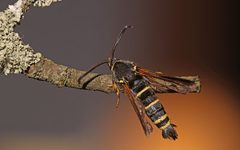
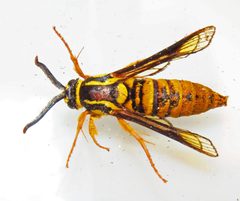
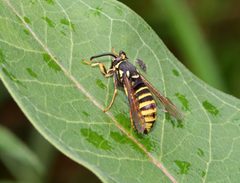
Paranthrene is a of clearwing moths in the Sesiidae, characterized by -mimicking appearance and activity. are distributed across North America, Europe, and Asia, with larvae that bore into woody stems of trees, particularly poplars and willows. Several species are significant forest pests, including the poplar clearwing (P. tabaniformis) and P. diaphana. The genus exhibits complex color that does not reliably indicate species boundaries, with some species containing multiple color morphs.
Pronunciation
How to pronounce Paranthrene: /pəˈrænθrəni/
These audio files are automatically generated. While they are not always 100% accurate, they are a good starting point.
Identification
within Paranthrene are morphologically similar and difficult to distinguish based on coloration alone. Color is common and not a reliable indicator of species boundaries; for example, P. robiniae was found to be polyphyletic with color variants distributed across multiple clades. Accurate identification requires examination of genitalic and molecular data. in is pronounced: females have antennae while males have pectinate antennae.
Images
Habitat
Associated with riparian and forested areas containing trees. include poplar and willow stands, urban plantings, and agricultural fields with scattered trees. Larvae develop inside the shoots and stems of host plants.
Distribution
Widespread across temperate regions of the Northern Hemisphere. In Europe: widespread including Bulgaria, Romania, and Scandinavia (Denmark, Norway, Sweden). In North America: distributed across the United States including Vermont, with ranging across various regions. In Asia: present from the Middle East (Iran) to East Asia (China, Japan).
Seasonality
are and active during daylight hours. period varies by and latitude. In Bulgaria, P. tabaniformis adults emerge from late April/early May through June or July, with peak activity in summer. Males of P. tabaniformis fly at heights up to 15 m in mature stands, with 90% flying below 3 m in young plantations.
Host Associations
- Populus spp. - larval Primary for P. tabaniformis; larvae bore into shoots and stems
- Salix spp. - larval Primary for P. diaphana, including Salix babylonica
- Rosa damascena - attractant source attracted to floral volatiles, particularly phenylacetaldehyde
- Apanteles evonymellae - Solitary endoparasitoid of early-stage larvae; causes 2.4-35.4% mortality
- Eriborus terebrans - Solitary internal larval ; causes up to 39% in summer
- Bracon intercessor - Gregarious external larval ; two per year
Life Cycle
Larvae are wood-borers that develop inside plant stems, progressing through five instars. occurs as larvae within host galleries. takes place in silk-and- constructed at gallery openings. emerge in spring to summer depending on and location.
Behavior
activity with -mimicking . are attracted to floral volatiles including phenylacetaldehyde and Rosa damascena ; attraction is enhanced under light conditions. Mated individuals show stronger attraction to floral compounds than virgin individuals. Males respond to via specialized olfactory receptor , with two types of receptor cell identified in single trichodea. Flight occurs at varying heights depending on stand age, with males patrolling along tree tops and vegetation.
Ecological Role
Larvae act as primary consumers of woody plant tissue in poplar and willow stands. Serve as for multiple including Apanteles evonymellae, Eriborus terebrans, and Bracon intercessor, contributing to complexity in forest and riparian .
Human Relevance
Several are significant forestry and urban tree pests. Paranthrene tabaniformis is a serious pest of poplar plantations and urban poplars. P. diaphana has become a notable pest of willows and poplars in Iran. Sex attractants have been developed for monitoring and attempted control through mass trapping, though efficacy in reducing levels has been limited. Potential for using phenylacetaldehyde and Rosa damascena as trap plants is under investigation.
Similar Taxa
- SesiaAnother of clearwing moths in Sesiidae; distinguished by differences in wing venation and genitalic
- SynanthedonRelated sesiid with similar -mimicking appearance; boundaries also challenging to determine, but differ in associations and geographic distribution
- BembeciaSesiid with overlapping distribution; differs in larval preferences and
Misconceptions
Color variants within Paranthrene were historically described as separate species, but molecular phylogenetic studies have shown that color is a poor indicator of species boundaries. Only two of nine examined color forms were monophyletic and associated with species-diagnostic .
More Details
Sensory Biology
Detailed ultrastructural studies of P. tabaniformis reveal seven types of antennal and three types of sensilla. in sensory equipment is pronounced: males possess more sensilla trichodea (olfactory function), while females have more sensilla basiconica ( function). This dimorphism suggests males rely more heavily on olfaction for mate location, while females emphasize gustatory assessment.
Taxonomic Complexity
Molecular phylogenetic analysis of North American revealed that P. robiniae was polyphyletic, leading to description of two new cryptic species: P. oasis and P. gilaensis. P. simulans was also found to be polyphyletic, and monophyly of P. pellucida was not recovered, indicating substantial cryptic diversity in the .
Sources and further reading
- BugGuide
- Wikipedia
- GBIF taxonomy match
- iNaturalist taxon
- NCBI Taxonomy
- Catalogue of Life
- Moths Can Mimic Bees, Too! | Bug Squad
- Antennal and proboscis sensilla characteristics of Paranthrene tabaniformis (Lepidoptera: Sesiidae)
- Bioecological characteristics of Bracon intercessor Nees (Hymenoptera: Braconidae) as a parasitoid of the poplar clearwing moth, Paranthrene tabaniformis (Rott.) (Lepidoptera: Sesiidae) in Bulgaria
- RESPONSES OF SINGLE OLFACTORY RECEPTOR CELL TO SEX PHEROMONES IN MALE MOTH PARANTHRENE TABANZFORMIS
- Studies on larval parasitoids of Paranthrene tabaniformis (Rott.) (Lepidoptera: Sesiidae) on urban poplars (Populus spp.) in Sofia, Bulgaria
- Evaluating the Trapping Potential of Rosa damascena and Phenylacetaldehyde for Paranthrene diaphana
- Studies on the efficacy of the sex attractant ofParanthrene tabaniformisRott. (Lep., Sesiidae)
- Notes on the biology and ecology of the parasitoids of the poplar clearwing moth, Paranthrene tabaniformis (Rott.) (Lep., Sesiidae) in Bulgaria. II. Eriborus terebrans (Gravenhorst, 1826) (Hym., Ichneumonidae)
- Notes on the biology and ecology of the parasitoids of the poplar clearwing moth, Paranthrene tabaniformis (Rott.) (Lep., Sesiidae) in Bulgaria. I. Apanteles evonymellae (Bouché, 1834) (Hym., Braconidae)
- Aposematic color polymorphism is a poor indicator of species boundaries in North American Paranthrene (Lepidoptera: Sesiidae) as evidenced by a multi-gene phylogeny
- Paranthrene diaphana: a new clearwing moth (Lepidoptera: Sesiidae) species in Romania and its preliminary response to sex attractants