
Synanthedon pini
(Kellicott, 1881)
pitch mass borer, Pitch Mass Borer Moth
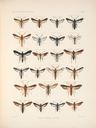
Synanthedon pini, commonly known as the pitch mass borer, is a clearwing moth in the Sesiidae. It is found in eastern North America, where it develops in the wood of pine and spruce trees. The larvae create pitch-filled tunnels in the inner bark and sapwood, causing defects in lumber but not killing trees. are active in mid-summer and have distinctive mostly clear wings.
Pronunciation
How to pronounce Synanthedon pini: /sɪˈnænθɪdɒn ˈpiːnaɪ/
These audio files are automatically generated. While they are not always 100% accurate, they are a good starting point.
Identification
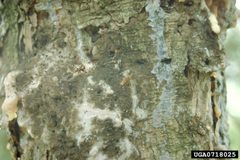
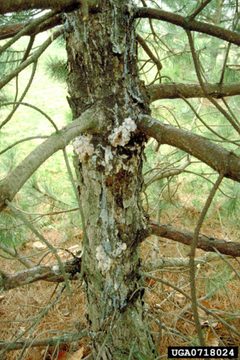
have mostly clear, membranous wings with reduced scaling, unlike the fully scaled wings typical of most . The body is -like in appearance, a common trait among sesiid moths. Adults are on wing in mid-July. Larvae are approximately 25 mm in length when mature, creamy white to pale, and found within pitch-filled tunnels in wood. occurs within the hardened pitch mass on the bark surface.
Images
Habitat
Forested and ornamental settings with conifers; found on spruce and pine . are laid on bark, typically near wounds, scars, or crevices.
Distribution
Eastern North America.
Seasonality
emerge and are active in mid-July. are laid in early summer. Larval development spans 2–3 years.
Diet
Larvae feed on the inner bark and sapwood of pine and spruce , including Austrian pine, eastern white pine, Scots pine, jack pine, white spruce, Norway spruce, and Colorado blue spruce.
Host Associations
- Pinus sylvestris - larval Scots pine
- Pinus strobus - larval eastern white pine
- Pinus nigra - larval Austrian pine
- Pinus banksiana - larval jack pine
- Picea glauca - larval white spruce
- Picea abies - larval Norway spruce
- Picea pungens - larval Colorado blue spruce
Life Cycle
are laid on bark in early summer, usually near wounds or in scars and crevices. Larvae feed in tunnels on the inner bark and sapwood for 2–3 years, reaching approximately 25 mm before pupating within the pitch mass. emerge in early summer, with activity in mid-July.
Behavior
Larvae cause a copious flow of pitch from their feeding tunnels, which hardens on the bark surface. This pitch mass serves as the site. are and have been observed to be relatively unresponsive to light traps, a trait common among many clearwing moth .
Ecological Role
A secondary pest of conifers; does not kill trees but degrades wood quality through larval tunneling. The contributes to nutrient cycling in forest through its wood-boring activity, though its economic impact is primarily negative due to lumber defects.
Human Relevance
Considered a minor forestry pest. Larval tunneling creates pitch-filled defects in lumber, reducing commercial value of affected timber. The does not cause tree mortality, limiting its management priority relative to more damaging forest pests.
Similar Taxa
- Synanthedon scitulaAnother eastern North American clearwing moth in the same ; distinguished by preferences and .
- Synanthedon acerniOccurs in the same region and is attracted to blacklights, unlike S. pini; differs in associations.
- Pennisettia marginataRaspberry cane borer, another sesiid with clear wings; distinguished by plant (Rubus ) and geographic range.
Sources and further reading
- BugGuide
- Wikipedia
- GBIF taxonomy match
- iNaturalist taxon
- NCBI Taxonomy
- Catalogue of Life
- First internet image of Phaenops piniedulis | Beetles In The Bush
- Bug Eric: Striped Pine Scale
- Bug Eric: That's Not an Ant?!
- Euhagena nebraskae… again | Beetles In The Bush
- Pests, Predators, and Parasitoids: Wasps Target Flies That Eat Hemlock Woolly Adelgid
- Tick Surveillance and Control Lagging in U.S., Study Shows