
Manduca florestan
Stoll, 1782
Florestan sphinx
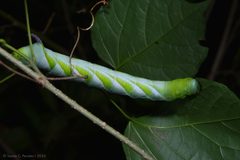
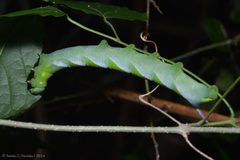
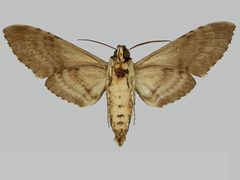
Manduca florestan, commonly known as the Florestan sphinx, is a large hawkmoth in the Sphingidae. are notable for their robust build and are attracted to mercury-vapor and ultraviolet light sources in oak-juniper woodland . The exhibits considerable geographic variation in period timing, with year-round activity in tropical regions and more restricted seasonal in temperate areas.
Pronunciation
How to pronounce Manduca florestan: /ˈmæn.dju.kə flɔːˈrɛs.tæn/
These audio files are automatically generated. While they are not always 100% accurate, they are a good starting point.
Identification
Distinguished from similar Manduca by geographic range and period. In the United States, fly from late June to early August, overlapping partially with M. sexta (Carolina sphinx) and M. rustica (rustic sphinx), but M. florestan tends to appear slightly earlier in the season than some in Arizona. The species is more frequently encountered at light traps than at flowers. Definitive identification often requires examination of genitalia or comparison with voucher specimens due to similarity to other large brown sphinx moths.
Images
Habitat
Occurs in oak-juniper woodland, mesquite-acacia scrub, and riparian corridors in arid and semi-arid regions. In the United States, found in mountainous areas of southern Arizona and New Mexico and in the lower Rio Grande Valley of Texas. Attracted to artificial light sources in these .
Distribution
Ranges from the southwestern United States (mountains of southern Arizona, southern New Mexico, and the lower Rio Grande Valley of southern Texas) south through Mexico, Belize, Guatemala, and Central America to Rica, and throughout much of South America including Venezuela, Brazil, Paraguay, Bolivia, Argentina, and Suriname.
Seasonality
In the United States, are on wing from late June to early August with one per year. In Bolivia, adults have been reported in March and from October to December. In Rica, adults fly year-round.
Host Associations
- Plumeria rubra - nectar source observed feeding on nectar in Rica
Life Cycle
One per year in the United States. Larval plants include in Bignoniaceae (Tecoma, Macfadyena, Pyrostegia), Verbenaceae (Citharexylum, Stachytarpheta, Callicarpa, , Vitex), Acanthaceae (Aegiphila, Cydista, Callichlamys), Bignoniaceae (Tabebuia), and Boraginaceae (Cordia). In Brazil, larvae have been reported on Lantana camara, Pyrostegia venusta, and Vitex megapotamica.
Behavior
are strongly attracted to mercury-vapor and ultraviolet light sources, frequently appearing at light sheets in oak-juniper woodland. Adults feed on nectar from various flowers. activity pattern typical of sphingid .
Ecological Role
function as when feeding on nectar. Larvae are herbivores that feed on leaves of woody plants in several , potentially serving as a food source for and .
Human Relevance
Occasionally encountered by entomologists and enthusiasts at light traps. No significant economic impact documented; larvae feed on native and ornamental plants but are not reported as agricultural pests.
Similar Taxa
- Manduca sextaSimilar large size and brown coloration; M. sexta has more northerly distribution and later period in Arizona (July–August), with distinctive black-and-white abdominal patterning not seen in M. florestan
- Manduca rusticaOverlaps in range and season; M. rustica has more contrasting wing patterns with distinct pale patches and flies slightly later in the season
More Details
Light attraction
Multiple observations document strong attraction to mercury-vapor and ultraviolet light setups in southeastern Arizona oak-juniper woodland, often appearing alongside other large sphingids such as Pachysphinx occidentalis and Eacles oslari