
Dolba hyloeus
Drury, 1773
Pawpaw Sphinx
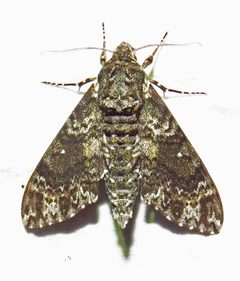
Dolba hyloeus, the pawpaw sphinx, is a in the Sphingidae. It is the only in the Dolba. The species is found throughout the eastern United States, where it has been documented from Maine to Florida and west to Wisconsin, Oklahoma, and Texas. are and attracted to light. The reflects the larval association with pawpaw trees (Asimina species).
Pronunciation
How to pronounce Dolba hyloeus: //ˈdɔlbə haɪˈliːəs//
These audio files are automatically generated. While they are not always 100% accurate, they are a good starting point.
Identification
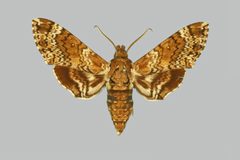
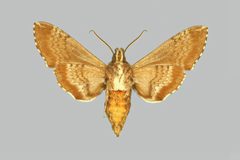
can be distinguished from other gray-brown sphinx moths by the combination of: relatively small size for Sphingidae; forewing pattern with irregular dark markings but lacking strong contrasting bands; small but distinct black discal spot on forewing; and gray hindwings with diffuse darker bands rather than clear eyespots or strong patterning. Similar include Sphinx drupiferarum (wild cherry sphinx), which has more uniform forewings and different associations, and Sphinx kalmiae (laurel sphinx), which has more contrasting wing patterns. Larvae are identified by the green ground color with pale diagonal stripes and association with Asimina host plants.
Images
Habitat
Deciduous forests and woodlands, particularly where pawpaw (Asimina) grows. Also found in forest edges, riparian corridors, and suburban areas with plant presence. Larval is specifically tied to stands of Asimina triloba (common pawpaw) and related .
Distribution
Eastern United States: Maine south to Florida, west to Wisconsin, eastern Oklahoma, and southern Texas. Absent from most of the Great Plains and western states. Northern limit appears to correspond with the range of the primary plant, Asimina triloba.
Seasonality
fly from late spring through summer, with peak activity June to August in most of the range. Multiple per year have been suggested for southern portions of the range, with one to two generations in northern areas. occurs as pupae.
Diet
Larvae feed on leaves of pawpaw trees, primarily Asimina triloba and other Asimina . do not feed; they rely on fat reserves accumulated during the larval stage.
Host Associations
- Asimina triloba - larval food plantprimary
- Asimina - larval food plant-level association
Life Cycle
Complete with , larva, pupa, and stages. Eggs are laid on leaves of plants. Larvae feed externally on foliage, progressing through five instars. Mature larvae descend to the ground to pupate in soil or leaf litter. Pupae overwinter. Adults emerge in spring and summer.
Behavior
are and strongly attracted to light sources. They are rapid, direct fliers typical of sphinx moths. Adults do not feed and have reduced mouthparts. Larvae are solitary feeders on plant foliage.
Ecological Role
Larval herbivore on Asimina . May contribute to local nutrient cycling through defoliation of pawpaw, though rarely abundant enough to cause significant plant damage. Serves as prey for birds, , and other natural enemies.
Human Relevance
Minor economic significance. Occasionally encountered by pawpaw growers but rarely a serious pest. Of interest to lepidopterists and naturalists due to its specialized association. are frequently recorded at light stations.
Similar Taxa
- Sphinx drupiferarumSimilar gray-brown forewings, but has more uniform wing pattern and different plants (Prunus )
- Sphinx kalmiaeSimilar size and build, but has more contrasting dark and light forewing bands
- Ceratomia catalpaeSimilar green larval form with horn, but feeds on Catalpa and has distinct larval striping pattern
Misconceptions
The 'pawpaw sphinx' is sometimes misapplied to other sphinx moth found near pawpaw trees. The species is occasionally confused with the more common Ceratomia species, though Dolba is readily distinguished by wing pattern and larval specificity.