
Erinnyis
Hübner, 1819
Species Guides
7- Elope sphinx(Alope sphinx)
- Erinnyis crameri(Cramer's sphinx)
- Erinnyis ello(ello sphinx)
- Erinnyis lassauxii(Lassaux's Sphinx)
- Erinnyis obscura(Obscure Sphinx)
- Erinnyis oenotrus(Oenotrus sphinx)
- Erinnyis yucatana
Erinnyis is a of sphinx moths (Sphingidae) established by Jacob Hübner in 1819, containing approximately 11 distributed across the Americas. Several species, notably E. ello and E. alope, are significant agricultural pests whose larvae feed on economically important plants including cassava, rubber, and papaya. The genus is characterized by medium to large hawkmoths with robust bodies and relatively narrow forewings. of E. ello are known to be parasitized by multiple Trichogramma species.
Pronunciation
How to pronounce Erinnyis: //ɛˈrɪn.nɪ.ɪs//
These audio files are automatically generated. While they are not always 100% accurate, they are a good starting point.
Identification
can be distinguished from other sphingid by the combination of narrow forewings, relatively plain wing patterning, and specific wing venation. E. ello and E. alope are particularly similar and require careful examination of genitalia or larval associations for definitive identification. The genus can be separated from related Dilophonotini by subtle differences in wing shape and pattern.
Images
Appearance
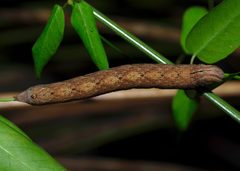
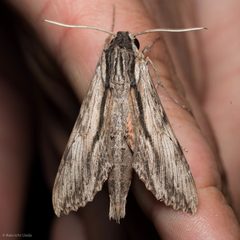
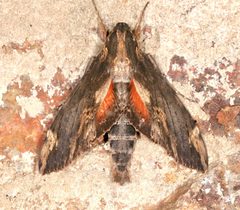
Medium to large sphinx moths with stout, streamlined bodies typical of the Sphingidae. Forewings are relatively narrow and elongated, with hindwings shorter and more rounded. Coloration varies by but generally includes cryptic brown, gray, or greenish tones. possess a long for nectar feeding. Larvae are hornworms with a characteristic horn and smooth, cylindrical bodies.
Habitat
Found in diverse environments from tropical lowlands to subtropical and warm temperate regions. Associated with agricultural areas, forest edges, and disturbed where plants occur.
Distribution
Widespread across the Americas. E. ello occurs from the southern United States through Central America and the Caribbean to Argentina. E. alope has a similar range, primarily in the southern United States, Mexico, Central America, the Caribbean, and South America. Other have more restricted distributions within the Neotropical and Nearctic regions.
Seasonality
are active year-round in tropical regions; in temperate areas, activity is restricted to warmer months. Multiple occur annually in favorable climates.
Diet
Larvae feed on plants in the Euphorbiaceae, principally cassava (Manihot esculenta), rubber (Hevea brasiliensis), and papaya (Carica papaya). feed on nectar from various flowers using their long .
Host Associations
- Manihot esculenta - larval food plantprincipal for E. ello
- Hevea brasiliensis - larval food plantsecondary
- Carica papaya - larval food plantprincipal for E. alope, also used by E. ello
- Euphorbia pulcherrima - larval food plantoccasional for E. ello
- Trichogramma - multiple parasitize of E. ello in Brazil
Life Cycle
Complete with , larva (), pupa, and stages. Larvae are solitary feeders on plant foliage. occurs in soil or leaf litter. Multiple per year in tropical climates.
Behavior
are strong fliers with rapid, direct typical of hawkmoths. or activity pattern. Larvae are solitary and feed exposed on plant leaves.
Ecological Role
Larvae function as herbivores on Euphorbiaceae, occasionally reaching pest densities in agricultural systems. Serve as for including Trichogramma . may contribute to pollination as nectar feeders.
Human Relevance
Several are significant agricultural pests, particularly E. ello (cassava ) and E. alope (pawpaw hornworm), causing defoliation and yield loss in cassava, rubber, and papaya plantations. Subject to research using Trichogramma .
Similar Taxa
- EumorphaSimilar body form and size, but Eumorpha typically has more patterned wings with distinct bands or eyespots, and different larval associations (primarily Vitaceae and Onagraceae rather than Euphorbiaceae)
- ManducaLarger size, broader forewings, and larvae with different horn ; Manduca typically feed on Solanaceae
More Details
Taxonomic history
Established by Jacob Hübner in 1819. The has undergone limited taxonomic revision; boundaries, particularly between E. ello and E. alope, have been clarified using morphological and molecular methods.
Pest management
E. ello is a major target for programs in Brazil, with multiple Trichogramma evaluated and deployed as . Cultural and chemical control methods are also employed.
Sources and further reading
- BugGuide
- Wikipedia
- GBIF taxonomy match
- iNaturalist taxon
- NCBI Taxonomy
- Catalogue of Life
- Caracterização de espécies de Trichogramma Westwood (Hymenoptera: Trichogrammatidae), parasitoides de ovos de Erinnyis ello (L.) (Lepidoptera: Sphingidae)
- Erinnyis alope . [Distribution map].
- Erinnyis ello . [Distribution map].
- Ecology and Control of Erinnyis ello and E. alope, Important Insect Pests in the New World
- On the identity of Trichogramma demoraesi Nagaraja (Hymenoptera: Trichogrammatidae), with a checklist and a key to Trichogramma species associated with Erinnyis ello (L.) (Lepidoptera, Sphingidae) in Brazil