
Elope sphinx
Drury, 1773
Alope sphinx
Erinnyis alope is a sphinx moth (Sphingidae) distributed across the Neotropics from northern South America through Central America to northern Mexico and the southern United States. The has been recorded as a stray as far north as Arkansas and Kansas. Two are recognized: the nominate E. a. alope and E. a. dispersa to the Galápagos Islands. The species is considered an agricultural pest, with larvae feeding principally on pawpaw (Carica papaya), and also recorded on rubber (Hevea brasiliensis) and cassava (Manihot esculenta).
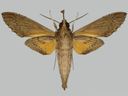
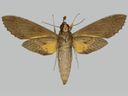
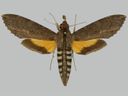
Pronunciation
How to pronounce Elope sphinx: /ɛˈrɪn.ɪ.ɪs ˈæ.loʊpi/
These audio files are automatically generated. While they are not always 100% accurate, they are a good starting point.
Images
Distribution
Northern South America (Argentina, Bolivia, Brazil, Colombia, Ecuador, French Guiana, Guyana, Paraguay, Peru, Suriname, Uruguay, Venezuela) through Central America (Belize, Rica, Guatemala, Panama) and the Caribbean (Bahamas, Barbados, Cayman Islands, Cuba, Dominican Republic, Guadeloupe, Haiti, Jamaica, Martinique, St Kitts-Nevis, St Lucia, St Vincent and Grenadines, Trinidad and Tobago, Virgin Islands) to northern Mexico and the southern United States (Arizona, Florida, New Mexico, Texas). Stray individuals recorded as far north as Arkansas and Kansas. E. a. dispersa is to the Galápagos Islands.
Diet
Larvae feed principally on pawpaw (Carica papaya). Also recorded feeding on rubber (Hevea brasiliensis) and cassava (Manihot esculenta).
Host Associations
- Carica papaya - larval plantprincipal
- Hevea brasiliensis - larval plant
- Manihot esculenta - larval plant
Ecological Role
Agricultural pest on economically important crops in the New World.
Human Relevance
Considered an important insect pest of pawpaw . Subject of ecological and control studies alongside the related Erinnyis ello.
Similar Taxa
- Erinnyis elloClosely related congeneric with similar and pest status; both are important agricultural pests in the New World studied together in control research.