
Erinnyis ello
Linnaeus, 1758
ello sphinx
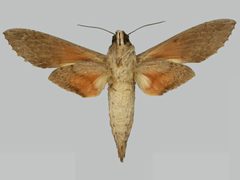
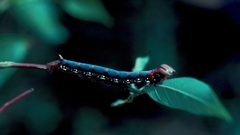
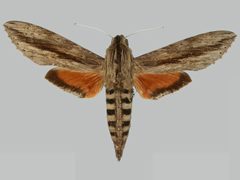
Erinnyis ello, the ello sphinx, is a sphingid distributed from Argentina through Central America to the United States. The was first described by Carl Linnaeus in 1758. It is a significant agricultural pest, particularly of cassava, and has been extensively studied for its relationships. Two are recognized: E. e. ello throughout the Americas and E. e. encantada to the Galápagos Islands.
Pronunciation
How to pronounce Erinnyis ello: /eˈrɪnˌnɪɪs ˈɛ.loʊ/
These audio files are automatically generated. While they are not always 100% accurate, they are a good starting point.
Identification
Medium to large sphinx moth with robust body and narrow, pointed forewings typical of the Sphingidae. Specific diagnostic features for distinguishing E. ello from such as E. alope are not provided in available sources.
Images
Distribution
Widespread in the Americas from Argentina north through Central America and the Caribbean to the United States, reaching as far north as Nevada. Present in Canada (Ontario), throughout the eastern and central United States, and across South America including Brazil, Colombia, Ecuador, Peru, and the Galápagos Islands.
Diet
Larvae feed primarily on cassava (Manihot esculenta). Also recorded on rubber (Hevea brasiliensis), pawpaw (Carica papaya), and poinsettia (Euphorbia pulcherrima).
Host Associations
- Manihot esculenta - primary larval plantcassava
- Hevea brasiliensis - larval plantrubber
- Carica papaya - larval plantpawpaw
- Euphorbia pulcherrima - larval plantpoinsettia
- Microplitis figueresi - braconid parasitizing larvae
- Telenomus dilophonotae - scelionid parasitizing
- Tetrastichus howardi - eulophid parasitizing pupae
- Trichogramma marandobai -
- Trichogramma manicobai -
Life Cycle
Complete with , larva, pupa, and stages. Pupae are parasitized by Tetrastichus howardi with reported rates of 64% and development from egg to adult in approximately 20 days at 25°C.
Ecological Role
Significant herbivore in agricultural and natural ; serves as for diverse including , larval, and pupal parasitoids.
Human Relevance
Major pest of cassava in the Neotropics. Subject of research targeting for .
Similar Taxa
- Erinnyis alopeCongeneric with overlapping distribution and similar ; both are important agricultural pests studied together for control methods
- Erinnyis ello encantada to Galápagos Islands; distinguished by geographic isolation and presumably derived morphological features
Sources and further reading
- BugGuide
- Wikipedia
- GBIF taxonomy match
- iNaturalist taxon
- NCBI Taxonomy
- Catalogue of Life
- Historical cave snail collection rediscovered in the attic
- Gastropoda | Blog - Part 2
- Tiny thorn snail found in Panama's backyard | Blog
- Three new mini thorn snail species | Blog
- Miniature Snail in a Rock Sandwich | Blog
- How Beekeepers Can Foster Propolis Production for Better Hive Health
- Erinnyis ello . [Distribution map].
- Caracterização de espécies de Trichogramma Westwood (Hymenoptera: Trichogrammatidae), parasitoides de ovos de Erinnyis ello (L.) (Lepidoptera: Sphingidae)
- Ecology and Control of Erinnyis ello and E. alope, Important Insect Pests in the New World
- On the identity of Trichogramma demoraesi Nagaraja (Hymenoptera: Trichogrammatidae), with a checklist and a key to Trichogramma species associated with Erinnyis ello (L.) (Lepidoptera, Sphingidae) in Brazil
- Distribution and characterization of oligomeric digestive enzymes from Erinnyis Ello larvae and inferences concerning secretory mechanisms and the permeability of the peritrophic membrane
- Parasitism and biological aspects of Tetrastichus howardi (Hymenoptera: Eulophidae) on Erinnyis ello (Lepidoptera: Sphingidae) pupae
- First record of Telenomus dilophonotae (Hymenoptera: Scelionidae), parasitizing eggs of Erinnyis ello (Lepidoptera, Sphingidae) in western Paraná, Brazil, with molecular characterization and records of occurrences
- Biology of Trichogramma marandobai and T. manicobai (Hymenoptera: Trichogrammatidae) in eggs of Erinnyis ello (Lepidoptera: Sphingidae)