
Enyo
Hübner, 1819
Species Guides
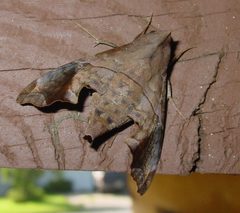
2- Enyo lugubris(Mournful Sphinx)
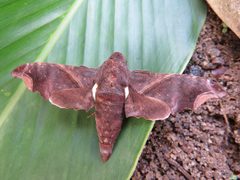
- Enyo ocypete(Swift-winged Sphinx)
Enyo is a of hawk moths (Sphingidae) established by Jacob Hübner in 1819. The genus comprises approximately 20–25 distributed primarily in the Neotropical region, with some species extending into the southern United States. are characterized by robust bodies, narrow forewings, and rapid, sustained typical of sphingids. Larvae feed on various plant , particularly Vitaceae and Bignoniaceae.
Pronunciation
How to pronounce Enyo: /ˈɛn.joʊ/
These audio files are automatically generated. While they are not always 100% accurate, they are a good starting point.
Identification
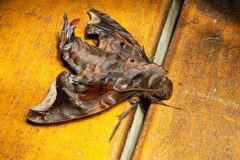
Enyo are distinguished from related Dilophonotini by forewing shape: forewings are relatively narrow and elongate with a straight or slightly convex outer margin, lacking the pronounced falcate (sickle-shaped) apex seen in some . Hindwings are small and rounded. The tapers to a point. are thickened toward the tip but not strongly clubbed. Species-level identification requires examination of genitalia and wing pattern details, particularly the presence and arrangement of discal spots and transverse lines on the forewing underside.
Images
Habitat
Tropical and subtropical forests, forest edges, and riparian corridors. Many are associated with humid lowland and montane environments. frequently occur in secondary growth and disturbed where larval plants are abundant.
Distribution
Neotropical region, from the southern United States (Arizona, Texas, Florida) through Mexico, Central America, and South America to northern Argentina. Greatest diversity occurs in Amazonian and Andean regions.
Seasonality
are recorded year-round in tropical lowlands; activity peaks vary regionally. In subtropical areas (southern USA), adults fly primarily from late spring through early autumn (May–October), with multiple .
Diet
feed on nectar from various flowering plants; specific floral associations are poorly documented for most . Larvae feed on Vitaceae (grape ), Bignoniaceae, and occasionally other families including Acanthaceae and Verbenaceae.
Host Associations
- Vitaceae - larval primary ; includes Cissus, Vitis, and related
- Bignoniaceae - larval secondary ; includes Catalpa, Macfadyena, and other woody vines and trees
Life Cycle
Complete . are laid singly on plant foliage. Larvae are hornworms with a characteristic caudal horn; coloration varies from green to brown with diagonal lateral stripes. occurs in a subterranean or in leaf litter. are and , with strong capabilities.
Behavior
are strong fliers capable of sustained hovering, though less specialized for this than Macroglossum or some other sphingid . They are attracted to artificial light. Larvae are solitary feeders.
Ecological Role
function as of night-blooming flowers. Larvae are herbivores that occasionally reach pest status on cultivated grapes and ornamentals.
Human Relevance
Larvae of Enyo lugubris (the mournful sphinx) occasionally defoliate grapevines and are considered minor agricultural pests in some regions. The is of interest to lepidopterists and ecological researchers studying plant-insect interactions in Neotropical systems.
Similar Taxa
- EumorphaSimilar size and general appearance; distinguished by broader, more triangular forewings with a more convex outer margin and often more complex wing patterns with prominent pink or yellow patches.
- DilophonotusFormerly confused with Enyo; distinguished by more pronounced falcate forewing apex and different genitalia structure.
- XylophanesOverlapping distribution and similar period; Xylophanes typically have more patterned forewings with distinct transverse bands and a more robust .
More Details
Etymology
The name derives from the Greek war goddess Enyo (Ἐνυώ), continuing a tradition of naming sphingid genera after classical figures.