
Enyo lugubris
Linnaeus, 1771
Mournful Sphinx
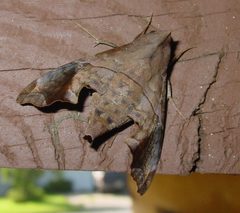
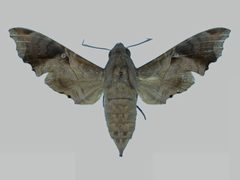
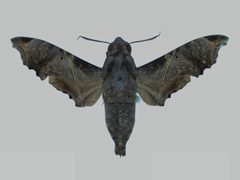
Enyo lugubris, commonly known as the mournful sphinx, is a sphingid with a broad Neotropical and Nearctic distribution. are medium-sized with a wingspan of 50–60 mm and are active year-round in tropical regions, with seasonal activity further north. The exhibits two : the nominate form across most of its range, and E. l. delanoi restricted to the Galápagos Islands. Larval development occurs on various Vitaceae species.
Pronunciation
How to pronounce Enyo lugubris: /ˈɛn.joʊ luˈɡuː.brɪs/
These audio files are automatically generated. While they are not always 100% accurate, they are a good starting point.
Identification
Distinguished from other Enyo by combination of size, wing pattern, and geographic range. Within its range, may be confused with other sphingid but can be separated by the 50–60 mm wingspan, relatively uniform dark forewings, and the pale hindwing areas. The nominate differs from E. l. delanoi of the Galápagos Islands in subtle wing pattern details. can be separated from similar Sphingidae by period and association in conjunction with wing .
Images
Appearance
Medium-sized with wingspan of 50–60 mm. Forewings typically dark with subtle patterning; hindwings usually with contrasting paler areas. Body robust, typical of sphingid moths. in : males possess more strongly bipectinate (feathered) antennae than females.
Habitat
Occurs in diverse tropical and subtropical including forests, woodlands, and disturbed areas with plant presence. In the United States, found in open woodlands, forest edges, and suburban areas with appropriate larval host plants. Associated with habitats supporting Vitaceae (grape ) vegetation.
Distribution
Widespread from South America through Central America, the Caribbean, and into the southern United States. Native range includes Argentina, Paraguay, Uruguay, Venezuela, Guyana, Suriname, French Guiana, Colombia, Ecuador, Peru, Brazil, the West Indies, Belize, Guatemala, Honduras, El Salvador, Nicaragua, Rica, Panama, Mexico, and the United States (Arizona east to Florida, north to South Carolina). Stray individuals recorded from Arkansas, Illinois, Michigan, and New York. E. l. delanoi to Galápagos Islands.
Seasonality
active year-round in tropical regions including southern Florida and Louisiana. In more northern parts of range (north of tropics), period extends from August to November. varies with latitude and local climate conditions.
Diet
Larvae feed on Vitaceae . Documented plants include Vitus tiliifolia, Vitis (grapes), Cissus (including C. sicyoides in Florida), and Ampelopsis (including A. arborea in Florida). feeding habits not explicitly documented in sources.
Host Associations
- Vitus tiliifolia - probable larval primary documented
- Vitis - larval grape
- Cissus sicyoides - larval documented in Florida
- Ampelopsis arborea - larval documented in Florida
Life Cycle
Complete with , larva, pupa, and stages. Larval development occurs on Vitaceae plants. Specific details of site and stage not explicitly documented. Multiple per year in tropical portions of range; likely single or partial second generation in temperate northern range.
Behavior
are and attracted to light. Strong fliers capable of long-distance , as evidenced by stray records well north of established breeding range. Adults have been documented visiting flowers, though specific nectar sources not detailed in available sources.
Ecological Role
Larval herbivore on Vitaceae, potentially contributing to nutrient cycling in forest . likely serves as when visiting flowers. Serves as prey for various vertebrate and . No specific ecological studies documented.
Human Relevance
Minor significance. Occasionally encountered by lepidopterists and naturalists. Not a significant agricultural pest despite larval feeding on grape-related plants. Presence in suburban areas with ornamental Vitaceae may provide observation opportunities for citizen scientists.
Similar Taxa
- Enyo ocypeteSimilar size and general appearance; distinguished by wing pattern details and more northern distribution in parts of range overlap
- Other Enyo species members share general body plan and size range; require examination of wing pattern, genitalia, and geographic distribution for definitive identification
More Details
Subspecies
Two recognized: Enyo lugubris lugubris (Linnaeus, 1771) throughout the main range, and Enyo lugubris delanoi Kernbach, 1962 restricted to the Galápagos Islands. The insular subspecies differs in subtle wing pattern elements.
Vagrancy
demonstrates significant capability with stray individuals recorded as far north as New York, Michigan, and Illinois, well beyond the established breeding range in the southern United States.
Sources and further reading
- BugGuide
- Wikipedia
- GBIF taxonomy match
- iNaturalist taxon
- NCBI Taxonomy
- Catalogue of Life
- Study Describes Three New Species of Fruit Flies and Revises Their Genus
- June | 2010 | Beetles In The Bush
- Tyrant ground beetles | Beetles In The Bush
- Research Confirms: (Insect) Moms Are the Best
- Beetle Collecting 101: Fermenting bait traps for collecting longhorned beetles | Beetles In The Bush
- Let’s make a deal! | Beetles In The Bush