
Pseudomasaris zonalis
(Cresson, 1864)
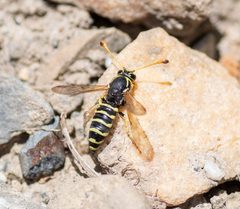
Pseudomasaris zonalis is a of pollen wasp in the Vespidae, Masarinae. Like other members of the Pseudomasaris, it is a solitary that provisions its nests with pollen and nectar rather than paralyzed prey. The species was described by Cresson in 1864. Pollen wasps in this genus are known for their specialized oligolectic relationships with certain flowering plants, particularly in the genera Penstemon, Phacelia, and Eriodictyon.
Pronunciation
How to pronounce Pseudomasaris zonalis: /ˌsjuːdoʊməˈsɛərɪs zoʊˈneɪlɪs/
These audio files are automatically generated. While they are not always 100% accurate, they are a good starting point.
Identification
Pseudomasaris zonalis can be distinguished from other vespid by the absence of the longitudinal fold present in other vespids when at rest. Males have long, clubbed , while females possess shorter clubbed antennae. This in antennae length is characteristic of the Pseudomasaris. The can be separated from other Pseudomasaris species by specific morphological details of coloration and pattern, though precise diagnostic features require expert examination.
Images
Habitat
Found in western North American where flowers occur. Associated with pinyon-juniper woodland, oak woodland, and other semi-arid to arid environments where its preferred floral hosts grow.
Distribution
Western North America. The Pseudomasaris has its center of diversity in western North America, with ranging from Washington and California east to Wyoming, Nebraska, and South Dakota.
Seasonality
active during summer months when flowers are in bloom. Males typically emerge before females, with peaks varying by locality and elevation.
Diet
feed on nectar. Females collect pollen and nectar from flowers, particularly Penstemon, Phacelia, and Eriodictyon, to provision nest . This oligolectic —specialized use of a limited range of pollen sources—distinguishes pollen wasps from predatory vespids.
Host Associations
- Penstemon - pollen/nectar sourceprimary floral for pollen collection
- Phacelia - pollen/nectar sourcedocumented floral
- Eriodictyon - pollen/nectar sourcedocumented floral
Life Cycle
Solitary nesting . Females construct earthen nests, typically attached to twigs or beneath stones depending on . Each nest contains multiple provisioned with pollen and nectar. An is laid in each cell, which is then sealed. Development proceeds through larval and pupal stages within the cell. Some species have nests that may be parasitized by cuckoo wasps such as Chrysurissa densa.
Behavior
Males exhibit , perching repeatedly in the same small areas on elevated terrain to encounter females. This behavior has been documented in related such as Pseudomasaris maculifrons, where males occupied the same locations for up to 29 days. Males patrol flower patches likely to be visited by females. Females are non-aggressive and do not defend territories.
Ecological Role
of specialized plants. The oligolectic relationship with Penstemon, Phacelia, and Eriodictyon suggests potential importance in pollination of these plant . As solitary , they do not form large colonies and thus have localized rather than widespread ecological impact.
Human Relevance
Generally harmless to humans. Unlike social vespids, pollen wasps are not defensive of nests and do not sting readily. They may be encountered by hikers and naturalists in western North American during summer months. Of interest to entomologists studying evolution, particularly the transition from predatory to pollen-feeding in Vespidae.
Similar Taxa
- Pseudomasaris vespoidesSimilar size, coloration, and ; both are pollen wasps with males exhibiting and females visiting Penstemon flowers. P. vespoides tends to attach nests to twigs in open situations.
- Pseudomasaris maculifronsClose relative with documented males; distinguished by specific pattern differences and distribution.
- Vespula spp. (yellowjackets)Superficially similar black and yellow coloration, but distinguished by social , predatory diet, presence of longitudinal fold at rest, and lack of clubbed .
More Details
Nesting biology
While most Pseudomasaris adhere nests beneath stones or in sheltered situations, nesting habits of P. zonalis specifically have not been documented in detail. The shows variation in nest placement, with some species like P. vespoides attaching nests to exposed twigs.
Taxonomic note
The Masarinae (pollen wasps) was historically treated as Masaridae in some classifications. Current systems generally place it as Vespidae: Masarinae. The Pseudomasaris is the only North American representative of this subfamily.