
Pseudomasaris vespoides
(Cresson, 1863)
pollen wasp
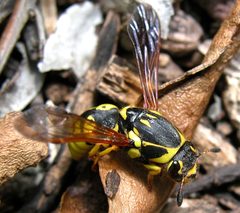
Pseudomasaris vespoides is a solitary pollen wasp in the Vespidae, Masarinae. Unlike social vespids that provision nests with prey, females construct mud nests and provision exclusively with pollen and nectar, resembling -like . The is strongly associated with Penstemon flowers, from which females collect pollen. Males are distinguished by their conspicuously long, clubbed and exhibit behavior on elevated terrain to locate females.
Pronunciation
How to pronounce Pseudomasaris vespoides: /ˌsjuːdoʊməˈsɛərɪs vɛsˈpɔɪdiːz/
These audio files are automatically generated. While they are not always 100% accurate, they are a good starting point.
Identification
Distinguished from other vespid by the absence of a longitudinal fold in the metasoma when at rest. Males uniquely identified by exceptionally long, clubbed . Females may be confused with yellowjackets but differ in (solitary, pollen-collecting) and nest construction (mud with pollen/nectar provisions rather than paper nests with insect prey).
Images
Habitat
Open, arid to semi-arid landscapes with abundant Penstemon flowers. Nests constructed on exposed twigs or branches, unlike most Pseudomasaris that nest under stones or in sheltered situations.
Distribution
Western North America: Washington south through California, Arizona, and New Mexico; east to Wyoming, Nebraska, and South Dakota. Also recorded in Baja California.
Seasonality
active primarily in summer; peak in late June. Males emerge before females and may persist longer at sites.
Diet
feed on nectar; females provision nests exclusively with pollen collected from Penstemon flowers (oligolectic relationship).
Host Associations
- Penstemon - pollen sourcePrimary and apparently obligate pollen ; oligolectic relationship
Life Cycle
Solitary nesting: female constructs mud nest of several attached to exposed twigs, provisions each cell with pollen and nectar, lays single per cell. Nest may be parasitized by cuckoo wasp Chrysurissa densa.
Behavior
Females visit Penstemon flowers to collect pollen, transporting it in a manner analogous to bees. Males exhibit , perching on elevated terrain to intercept females. Males of related have been documented maintaining territories for up to 29 days. Courtship involves male tapping on female's back with and abdominal structures.
Ecological Role
Specialized of Penstemon; oligolectic pollen collection suggests mutualistic relationship with this plant . Nests provide resource for .
Human Relevance
Generally harmless; lacks defensive stinging typical of social . May be mistaken for yellowjackets but poses no nest-defense threat. Ecological interest as an example of toward -like provisioning behavior in wasps.
Similar Taxa
- Pseudomasaris maculifronsSimilar pollen wasp with male , but differs in male behavior patterns and geographic range
- Vespula/YellowjacketsSuperficially similar coloration and size, but social, nest in paper colonies, provision with insects rather than pollen, and possess metasomal fold at rest
- Pseudomasaris edwardsiiSmaller congeneric with similar but different geographic range and nesting habits
More Details
Nesting biology
Unlike most Pseudomasaris that adhere nests beneath stones or in sheltered locations, P. vespoides characteristically attaches nests to exposed twigs, making them visible to observers.
Historical research
has been subject of behavioral studies documenting male and female pollen-collection; early 20th century work by Bradley and others established basic .
Sources and further reading
- BugGuide
- Wikipedia
- GBIF taxonomy match
- iNaturalist taxon
- NCBI Taxonomy
- Catalogue of Life
- Bembicid Holdings | Entomology Research Museum
- Bug Eric: Wasp Wednesday: Wasps in Love
- Bug Eric: November 2011
- Bug Eric: More Hilltopping Insects
- Eumastacidae | Beetles In The Bush
- PSEUDOMASARIS EDWARDSII CRESSON, ANOTHER POLLEN-PROVISIONING WASP, WITH FURTHER NOTES ON P. VESPOIDES (CRESSON)