
Pseudomasaris macswaini
Bohart, 1963
pollen wasp
Pseudomasaris macswaini is a of pollen in the Vespidae, Masarinae. It is one of 14 species in the Pseudomasaris, which is the only genus of pollen wasps occurring in North America. Like other masarine wasps, it is solitary and provisions its nest with pollen and nectar rather than paralyzed prey. The species was described by Bohart in 1963 and is known from western North America.
Pronunciation
How to pronounce Pseudomasaris macswaini: /ˌsjuːdəʊˈmæsərɪs mækˈsweɪni/
These audio files are automatically generated. While they are not always 100% accurate, they are a good starting point.
Identification
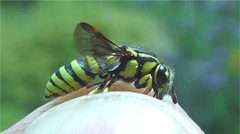
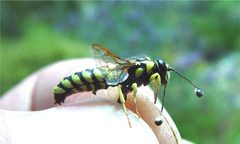
Pseudomasaris macswaini can be distinguished from other Pseudomasaris by its yellowish coloration and distinct sutural maculae (spots along the elytral ) on the wings. Males have long, clubbed , while females have shorter, clubbed antennae. Unlike social vespids, pollen wasps lack the longitudinal fold on the when at rest. The species is similar in size to yellowjacket but can be separated by the clubbed antennae and absence of the abdominal fold.
Images
Habitat
Occurs in rabbitbrush chaparral , specifically associated with Chrysothamnus viscidiflorus. Found in west-central Nevada in areas with sandy soils suitable for nest construction.
Distribution
Restricted to a small area in west-central Nevada. The type locality is 19 miles southeast of Wellington, Douglas County, Nevada. have been documented near Wellington and in surrounding areas of Lyon and Douglas counties.
Seasonality
are active during summer months. Based on related in the , males likely emerge before females, with peak activity in late June to July.
Diet
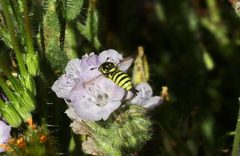
feed on nectar from flowers. Females provision nest with pollen and nectar, collected primarily from Penstemon, Phacelia, and Eriodictyon . This oligolectic relationship with specific floral is characteristic of the .
Life Cycle
Solitary nesting . Females construct earthen nests of several , typically attached beneath stones or other sheltered situations, though some species in the attach nests to exposed twigs. Each cell is provisioned with pollen and nectar and contains a single . Larvae develop on this pollen-nectar diet.
Behavior
Males exhibit , perching repeatedly in the same small area on hilltops or peaks to encounter females. This territorial perching behavior can persist for up to 29 days. Males are known to patrol patches of flowers likely to be visited by females. Females dig burrows or use pre-existing cavities for nesting.
Ecological Role
of Penstemon, Phacelia, and Eriodictyon through its oligolectic pollen-collecting . The specialized pollination relationship suggests potential importance for native plant in its restricted range.
Human Relevance
Non-aggressive solitary with no known negative impacts on humans. May be of interest to pollination biologists and hymenopteran . Nests may be parasitized by cuckoo wasps such as Chrysurissa densa.
Similar Taxa
- Pseudomasaris vespoidesSimilar size and general appearance, but P. macswaini has distinct sutural maculae and more yellowish coloration versus the reddish tones of P. vespoides. P. vespoides has a broader distribution across western North America from Washington to South Dakota.
- Pseudomasaris maculifronsBoth are western North American pollen wasps with yellowish coloration, but P. maculifrons is known from Arizona and exhibits pronounced on Sentinel Peak near Tucson. P. macswaini is restricted to Nevada and has different maculation patterns.
- Pseudomasaris immaculipennisOccurs sympatrically in west-central Nevada with reddish legs, pale color, and complete lack of elytral markings in males. The two have been found at the same locality without evidence of intergradation, suggesting possible reproductive isolation.
More Details
Taxonomic Uncertainty
The relationship between P. macswaini and P. immaculipennis requires further study. Both of Crossidius hirtipes (immaculipennis and macswaini) were described by Linsley & Chemsak based on color and maculation differences. They have been found at the same site without intergradation, raising questions about whether they represent distinct rather than subspecies. sequence analysis is needed to resolve this uncertainty.
Nesting Biology
While direct observations of P. macswaini nesting are not documented in available sources, the Pseudomasaris is known for constructing earthen nests of several provisioned with pollen and nectar. Nests are typically concealed under stones or attached to twigs, with females using mud for construction.