
Ancistrocerus adiabatus cytainus
(Cameron, 1906)
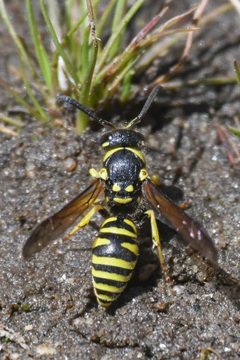
Ancistrocerus adiabatus cytainus is a of mason wasp in the Vespidae, Eumeninae. As a member of the Ancistrocerus, it shares the characteristic transverse carina (ridge) on the base of the first abdominal segment that distinguishes this genus from other eumenine . The subspecies was described by Cameron in 1906. Like other mason wasps in this genus, it is presumed to be a solitary nester that provisions its offspring with paralyzed caterpillars.
Pronunciation
How to pronounce Ancistrocerus adiabatus cytainus: /ænˈsɪstrəs ɛrəs ædiˈeɪbətəs saɪˈteɪnəs/
These audio files are automatically generated. While they are not always 100% accurate, they are a good starting point.
Identification
Ancistrocerus can be distinguished from other mason wasps by a prominent transverse carina (ridge) on the base of the first abdominal segment (T1), creating an abrupt angle facing the rear of the . Other in the Eumeninae have a more gently sloping toward the thorax. Males of Ancistrocerus can be identified by hooked tips on their . -level identification of A. adiabatus cytainus requires examination of specific color pattern details and geographic origin.
Images
Distribution
Recorded from Vermont, USA. The parent Ancistrocerus adiabatus has a broader distribution, but specific range details for this are limited in available sources.
Ecological Role
As a solitary predatory , Ancistrocerus function as agents of caterpillar . The is known to prey on larvae, particularly from Tortricidae, Amphisbatidae, and Gelechiidae. This likely contributes to regulation of herbivorous insect populations in its .
Similar Taxa
- Ancistrocerus unifasciatusSimilar size range and general body form; distinguished by specific abdominal color pattern details and geographic distribution
- Ancistrocerus campestrisOverlaps in eastern North American distribution; A. campestris has yellow hind margins on the first three abdominal segments and different prey preferences
- Ancistrocerus waldeniiConstructs similar free-form mud nests attached to hard surfaces; distinguished by white or yellow abdominal markings and specific nest architecture
More Details
Taxonomic Status
Accepted as a valid by Catalogue of Life and GBIF, with 110 observations recorded in iNaturalist as of data retrieval. The subspecific epithet 'cytainus' was established by Cameron in 1906.
Sources and further reading
- BugGuide
- GBIF taxonomy match
- iNaturalist taxon
- Catalogue of Life
- Bug Eric: Wasp Wednesday: Walden's Mason Wasp, Ancistrocerus waldenii
- Bug Eric: How to (Almost) Catch a Leaf-tier Caterpillar (Video)
- Bug Eric: How to Catch a Leafroller Caterpillar (Video)
- Bug Eric: Eight Illinois Wasp and Bee Mimics in Twenty Minutes
- Bug Eric: City Nature Challenge 2023 Recap