
Euura
Newman, 1837
Species Guides
18- Euura alaskensis(Yellowheaded Spruce Sawfly)
- Euura appalachia
- Euura aurantiaca
- Euura calais
- Euura californica(Willow Apple Gall Sawfly)
- Euura corniger
- Euura extensicornis
- Euura hispidae
- Euura iridescens
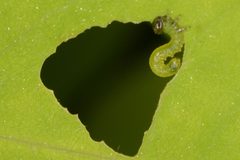
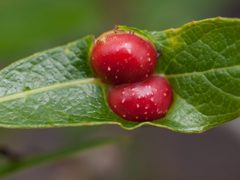
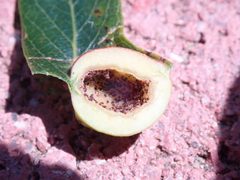
Euura is a of in the Tenthredinidae, Nematinae, with exceptional concentrated in northern Holarctic regions rather than tropical zones. The genus contains both free-feeding larvae that consume plant foliage externally and gall-inducing whose larvae develop entirely within plant galls. Gall-forming females inject a stimulant during oviposition that initiates gall growth before hatch, a distinctive mechanism among gall insects. Taxonomic revision in 2014 consolidated several former genera (Eupontania, Phyllocolpa, Pontania, Tubpontania) into Euura based on phylogenetic evidence. The genus exhibits substantial genetic complexity, with frequent mito-nuclear discordance and multiple functional COI variants within individuals complicating species identification.
Pronunciation
How to pronounce Euura: /ˈjuː.ʊ.rə/
These audio files are automatically generated. While they are not always 100% accurate, they are a good starting point.
Identification
Identification of Euura relies heavily on plant associations, as morphological and genetic characters often fail to distinguish closely related . Gall provides diagnostic characters for gall-inducing species, with illustrated keys available for 66 northern European species based on morphology and gall structure. COI barcodes alone are unreliable for over 50% of species; nuclear markers (NaK, POL2) show better congruence with morphology but still leave approximately 15% of species ambiguously identifiable. Males of many species remain unknown or difficult to identify morphologically, while females are more readily distinguished. Within-species genetic diversity averages 0.3% haplotype divergence but can reach 1.4%, overlapping with between-species divergence in some groups.
Images
Habitat
Northern Holarctic regions, particularly forest zones and northern Europe; extends into high alpine and high mountain . Associated with Salix (willow) plants throughout the Western Palaearctic; some occupy forest tundra and subarctic regions. In North America, at least five species gall poplars (Populus), though reports of European poplar-galling species remain unconfirmed.
Distribution
West Palaearctic (164 treated in recent revision, with 102 previously revised); northern Europe including Sweden (55 species), Norway, Finland, Germany, Austria. Records from high mountain , Bear Island, Swiss National Park, Kullaberg (Sweden), and northern Ob basin. East Palaearctic species present; Nearctic distribution includes North American species galling both Salix and Populus. Euura lipovskyi recently recorded in Canada (Ontario) from native eastern US range extending to Pacific northwest and Europe.
Seasonality
Spring responsive to global warming in northern ; hibernation and synchrony documented in subarctic populations. activity and gall formation occur during willow growing season; specific timing varies by and latitude.
Diet
Herbivorous; larvae feed on plant tissue. Free-feeding consume willow foliage externally. Gall-inducing species feed on gall tissue initiated by female oviposition stimulants. The amentorum species group larvae develop entirely within female Salix catkins, with some species boring in central stalks and others feeding externally on developing seeds.
Host Associations
- Salix (willows) - primary for 80% of West Palaearctic ; most species monophagous on single willow species, though E. mucronata on over 30 Salix species
- Populus (poplars) - confirmed At least five North American gall poplars; European poplar associations unconfirmed
- Rhododendron - Euura lipovskyi and E. azaleae feed on Rhododendron section Pentanthera
Life Cycle
laid into plant tissue (foliage, stems, or catkins) with gall-inducing females injecting stimulants that initiate gall formation before hatching. Larvae complete development within galls or feed externally on plants. occurs in soil after larvae exit galls or leave feeding sites. Gall-inducing show strict association with specific host plant species, with larval development entirely contained within gall structure.
Behavior
Gall induction represents the most distinctive : females inject secretions during oviposition that trigger abnormal plant growth, initiating gall formation before larval . This proactive gall initiation contrasts with most gall insects where galls form in response to larval presence. Resource regulation behavior documented in E. mucronata: galling attack stimulates plant growth responses that increase resource availability for subsequent . Host preference shows genetic differentiation correlating with host use in some .
Ecological Role
Herbivores in forest and tundra ; gall formation creates structured for associated organisms. Tri-trophic interactions documented: willow-gall- systems support complex . Galls may influence willow growth patterns and resource allocation; heavy attack can cause substantial injury. Interactions with insectivorous birds and mammalian herbivores (elk) documented in ecosystem studies.
Human Relevance
Subject of extensive taxonomic research due to complex boundaries and ecological specialization. Some species cause substantial injury to cultivated willows and poplars under heavy attack. Euura lipovskyi (Azalea Sawfly) recognized as pest of cultivated Rhododendron. Historical significance in entomology: first published gall description by Francesco Redi (1668) for E. proxima; early microscopy by Leeuwenhoek on willow galls.
Similar Taxa
- Pontania (historical)Formerly separate of gall-inducing , now synonymized within Euura based on 2014 phylogenetic revision; previously distinguished by gall and associations
- Phyllocolpa (historical)Former of free-feeding and gall-associated transferred to Euura in 2014; historical distinction based on larval feeding mode and
- NematusRelated nematine ; Euura distinguished by gall-inducing in many and characteristic female oviposition stimulants
- PristiphoraRelated nematine ; Euura often distinguished by more specialized associations and gall-forming
Sources and further reading
- BugGuide
- Wikipedia
- GBIF taxonomy match
- iNaturalist taxon
- NCBI Taxonomy
- Catalogue of Life
- West Palaearctic species of Euura Newman, 1837 (Hymenoptera, Tenthredinidae)
- North European gall-inducing Euura sawflies (Hymenoptera, Tenthredinidae, Nematinae)
- HOST PREFERENCE AND ALLOZYME DIFFERENTIATION IN SHOOT GALLING SAWFLY,EUURA ATRA
- Aspects of the biology of Euura amerinae (Linnaeus) (Hymenoptera, Tenthredinidae)
- Population ecology of a gall-inducing sawfly, Euura lasiolepis, and relatives
- Host Preference and Allozyme Differentiation in Shoot Galling Sawfly, Euura atra
- The Arroyo Willow Stem-galling Sawfly, Euura lasiolepis (Hymenoptera: Tenthredinidae): A Pictorial Life History
- First record of Azalea Sawfly (<i>Euura lipovskyi</i>, Hymenoptera: Tenthredinidae) in Canada
- Palaearctic willow-catkin sawflies: a revision of the amentorum species group of Euura (Hymenoptera, Tenthredinidae)
- The host plants of <i>Euura cinereae</i> Kopelke, 1996 and <i>E. auritae</i> Kopelke, 2000 (Hymenoptera: Tenthredinidae)
- Field test of resource regulation by the bud‐galling sawfly, Euura mucronata, on Salix cinerea
- Niche Differentiation and Predicted Functions of Microbiomes in a Tri-Trophic Willow-Gall (Euura viminalis)-Parasitoid Wasp System.