
Hoplocampa testudinea
(Klug, 1816)
apple sawfly, European apple sawfly
Hoplocampa testudinea is a in the Tenthredinidae that is a significant pest of apple orchards. Native to Europe, it was accidentally introduced to North America in 1939 and has since become across the northeastern United States and Canada. The larvae develop inside developing apple fruitlets, causing characteristic ribbon scars or fruit drop, while are active during apple bloom and oviposit into the calyx of flowers.
Pronunciation
How to pronounce Hoplocampa testudinea: //ˌhɒpləˈkæmpə tɛˈstjuːdɪniə//
These audio files are automatically generated. While they are not always 100% accurate, they are a good starting point.
Identification
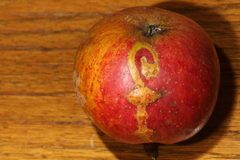
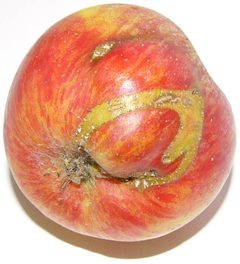
are small (≤5 mm) with brownish-black / and brown . Larvae are creamy-white with brown heads and seven pairs of abdominal legs, unlike codling moth larvae which are pinkish-white with five pairs. Larval activity begins two to three weeks earlier than codling moth. Characteristic damage includes ribbon scars on fruit skin from initial larval burrowing, and fruitlets with large entry holes clogged with brown sticky .
Images
Habitat
Apple orchards and areas with cultivated apple (Malus spp.) trees. are attracted to open apple flowers on warm sunny days. Larvae develop within developing fruitlets. occurs in soil at 10–25 cm depth in constructed cocoons.
Distribution
Native to Europe, widespread between 40° and 60° north latitude, including western areas of the former USSR and northern Turkey. Introduced to North America: first detected on Long Island, New York in 1939; spread to Vancouver Island, British Columbia in 1940; reached Quebec by 1979 and Ontario by 1987. Present across northeastern United States and southeastern Canada.
Seasonality
emerge in late spring, synchronized with apple tree flowering. hatch approximately five days after oviposition, when about 80% of petals have fallen. Larval activity in fruitlets occurs two to three weeks earlier than codling moth. Larvae complete development in summer; damaged fruitlets fall to ground. occurs in spring after , with some individuals exhibiting prolonged lasting two or occasionally three years.
Diet
Larvae feed on developing tissue of apple (Malus spp.) fruitlets, initially burrowing under the skin and later tunneling to the core. As larvae grow, they tunnel outward and may move into adjoining fruitlets. do not feed; they are attracted to apple flowers for oviposition.
Host Associations
- Malus pumila - primary cultivated apple; sole confirmed for larval development
- Malus spp. - -level association
Life Cycle
Holometabolous development with potential prolonged . emerge in late spring during apple bloom and live 1–2 weeks. Females oviposit single in slits below the calyx. Eggs hatch in ~5 days; larvae enter fruitlets and develop through instars, eventually causing fruit drop. Mature larvae descend to soil and construct papery cocoons 10–25 cm underground to overwinter. occurs in spring; 17–26% of adults emerge after one year, 1–9% after two years, with rare three-year recorded. Pupae are susceptible to desiccation and fungal .
Behavior
are attracted to open apple flowers on warm sunny days and exhibit discrimination when selecting oviposition sites, with olfaction playing a role in cultivar discrimination. Females typically deposit one per flower. Larvae exhibit host discrimination in feeding site selection. Some individuals undergo prolonged , remaining in cocoons for two or three years, which may serve as a strategy.
Ecological Role
Primary consumer and herbivore of apple fruit tissue. Serves as for multiple including Lathrolestes ensator (larval parasitoid) and Aptesis nigrocincta (cocoon parasitoid). In Europe, natural enemy complex helps regulate ; in North America, absence of these natural enemies contributes to pest status. fungi ( fumosoroseus, Metarhizium spp., bassiana, others) can cause mortality in soil-dwelling stages.
Human Relevance
Major economic pest of apple production, particularly in eastern North America where losses can reach 80% in some areas. Larval feeding causes direct fruit damage: ribbon scars render fruit unmarketable, while heavy cause premature fruit drop. Certain dessert apple varieties (Discovery, Worcester Pearmain) are especially susceptible. Management relies on monitoring with sticky traps, through introduced Lathrolestes ensator, (Steinernema carpocapsae, S. feltiae, Heterorhabditis bacteriophora), fungal biocontrol agents, and (quassin/neoquassin from Quassia amara) in organic systems. Synthetic insecticides timing challenges due to bloom-period activity.
Similar Taxa
- Cydia pomonella (codling moth)Both are internal feeders of apple fruit; codling moth larvae are pinkish-white with five pairs of abdominal legs versus creamy-white with seven pairs in H. testudinea, and codling moth is active 2–3 weeks later in the season
- Hoplocampa brevisRelated in same ; specific distinguishing features require examination of morphological details not detailed in available sources
Sources and further reading
- BugGuide
- Wikipedia
- GBIF taxonomy match
- iNaturalist taxon
- NCBI Taxonomy
- Hoplocampa testudinea . [Distribution map].
- Host Discrimination by Adult and Larval European Apple Sawflies Hoplocampa testudinea (Klug) (Hymenoptera: Tenthredinidae)
- Bioecology, Harm And Efficiency Of Certain Preparations Against The Apple Fruit Sawer (Hoplocampa Testudinea Klug.)
- Effect of Apple Rootstock on Hoplocampa testudinea (Klug) Host Choice and Larval Performance
- STUDIES ON TWO ICHNEUMONID PARASITOIDS AS POTENTIAL BIOLOGICAL CONTROL AGENTS OF THE EUROPEAN APPLE SAWFLY HOPLOCAMPA TESTUDINEA KLUG (HYMENOPTERA: TENTHREDINIDAE)
- Apple cultivar preferences byHoplocampa testudinea(Hymenoptera: Tenthredinidae) in the Annapolis Valley of Nova Scotia, Canada
- Life history ofAptesis nigrocincta(Hymenoptera: Ichneumonidae) a cocoon parasitoid of the apple sawfly,Hoplocampa testudinea(Hymenoptera: Tenthredinidae)
- Releases and first recovery ofLathrolestes ensator(Hymenoptera: Ichneumonidae) in North America, a parasitoid ofHoplocampa testudinea(Hymenoptera: Tenthredinidae)
- Some Notes on the Biology of the Apple Sawfly,Hoplocampa Testudinea(Klug)
- The apple sawfly, Hoplocampa testudinea: Temperature effects on adult life‐span and reproduction
- Apple sawfly Hoplocampa testudinea (Hym., Tenthredinidae) and its parasitoid Lathrolestes ensator in Dutch apple orchards (Hym., Ichneumonidae, Ctenopelmatinae)
- Impact of the parasitoidLathrolestes ensator(Hym., Ichneumonidae, Ctenopelmatinae) as antagonist of apple sawflyHoplocampa testudinea(Hym., Tenthredinidae)